Surface-laser a logo onto optical crystal and the piece arrives looking powdered. Frosted. Washed-out.
The proof looked fine on screen, because surface laser always looks fine on screen. It’s only in physical light, on stage, under the spot, that it falls apart. The CEO presents it anyway, nobody comments, and everybody notices.
That’s the whole point of this guide. Each material has one or two engraving methods that look brilliant and a handful that look mediocre. Here’s the right method for every material, how the Malaysian scripts behave, and the ten mistakes that quietly wreck good pieces.
Short answer: Match the method to the material. Crystal takes inner laser only (never surface laser). Acrylic takes laser etch for text, UV print for colour, or CNC for cut-out shapes. Wood takes laser, CNC relief, or a brass nameplate. Soft metals take rotary engraving; hard metals take laser annealing. Get the method right first; layout and font come second. Engraving is free on every piece.
The material × method matrix
| Material | Best method | Avoid |
|---|---|---|
| Crystal | Inner laser (sub-surface 3D) | Surface laser — frosts the surface, looks washed |
| Acrylic | Laser etch (text), UV print (colour), CNC (cut-outs) | Nothing — choose by brief, not exclusion |
| Wood | Laser (light woods), CNC (heritage relief), brass plate | UV print — doesn’t bond well to grain |
| Soft metal (brass, aluminium, soft pewter) | Rotary engraving | Laser surface etch — too faint |
| Hard metal (stainless, anodised) | Laser annealing (colour change) | Rotary — chips edges |
| Pewter | Rotary, or engraving on a separate plate | Direct laser on cast pewter — mark too faint |
Engraving is free on all of them. Crystal and acrylic turn around fast; wood adds about a week with a 10× minimum order; custom shapes run a few weeks.
Why the method decides the whole piece
Engraving is what turns a stock catalogue trophy into a personalised award. Get it right and an acrylic block reads as something more expensive on stage. Get it wrong and even a fine crystal sculpture looks like a bundle-deal trophy.
The dominant variable is the method matched to the material. Each material has a native technique. Layout and font only matter once the method is right.
Crystal cannot be surface-lasered cleanly. If a supplier offers it, find a different supplier. I’ve re-made too many “powdered logo” CEO awards from previous engravers to phrase that any softer.
Crystal: inner laser only
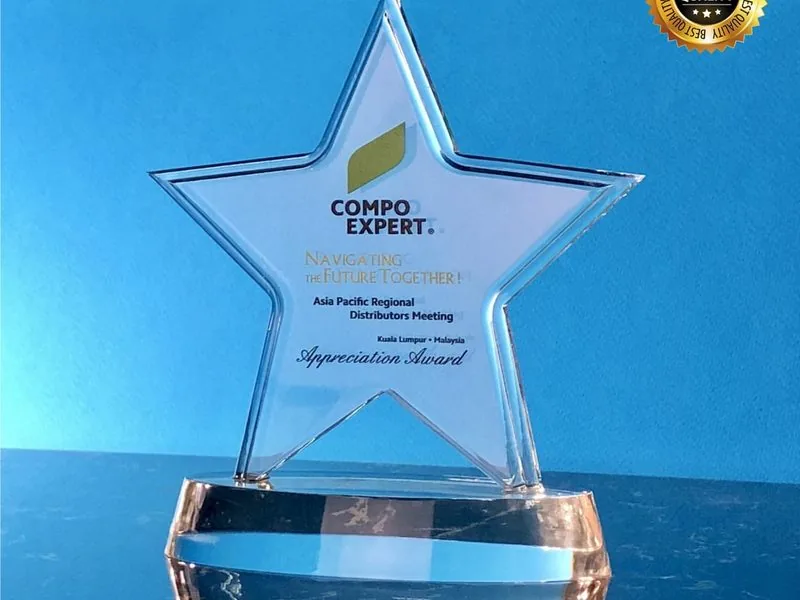
Crystal is the most prestigious trophy material, and it has exactly one engraving method that works well: sub-surface inner laser, sometimes called 3D laser engraving. A focused laser pulses inside the crystal, creating microscopic fractures that form the image or text. The surface stays smooth and the engraving floats inside the block.
Surface laser scratches the surface and leaves a dull frosted patch. On clear crystal that should refract light, that reads washed-out and amateur, so I never use it on crystal.
Inner laser does names, dates, and citation text in clean fonts beautifully, along with logos (supplied as vector or high-resolution raster) and 3D geometric shapes. It struggles with very thin script fonts, small photographs of people, and full colour (inner laser is single-tone). For colour on crystal, the route is UV print on the base the crystal sits on, with inner laser reserved for the block itself. Browse the crystal trophies range.
Acrylic: three methods, three jobs
Acrylic is the most flexible material, taking three methods. Laser etching burns a frosted mark into the surface: crisp text, clean lines, fast on bulk runs, but single-tone. UV printing lays full-colour ink on the surface and cures it: full colour, gradients, photos, though it sits on the surface so it suits display pieces rather than daily-handled objects (the laser vs UV deep-dive covers the trade-off). CNC routing physically cuts the acrylic into shapes or recessed channels: a chunky, premium, tactile look that’s slower and best on display awards.
So: all-text goes to laser etch, full-colour logos to UV print, sculptural awards to CNC (often with UV print on the base).
Wood: laser, CNC, and the brass nameplate
Wood plaques take three approaches, often combined. Laser engraving burns a darker scorched line, with contrast depending on the wood; light woods like beech take it with high contrast, while darker woods need deeper settings. CNC routing carves a deeper relief than laser, for heritage pieces where the engraving needs to feel substantial. And the brass nameplate on a wood backing is the format most formal Malaysian corporate plaques use: the wood gives heritage warmth, the brass gives crisp permanent engraving.
Remember wood carries a 10× minimum order and about an extra week. The acrylic vs wood comparison covers when each format wins.
Metal: rotary, laser annealing, chemical etch
Metal awards split by metal type. Rotary engraving uses a spinning bit to cut a fine, clean line into softer metals (brass, aluminium, soft pewter), with a slightly hand-engraved feel that suits nameplates.
Laser annealing heats the surface of harder metals (stainless, anodised aluminium) to cause a controlled colour change, usually dark on steel, permanent and smooth. Chemical etching is for badge-quality medals with fine relief, mostly on regimental and military-style pieces. For pewter, the pewter buyer’s guide covers its own rules, since the metal is soft and reactive.
Multilingual engraving: BM, English, Mandarin, Tamil, Jawi
Malaysian orders frequently mix languages on one award. Get the script handling wrong and a bilingual long-service plaque reads as a smudge to the one person in row two who reads it natively.
| Script | Min size | Common pitfall |
|---|---|---|
| Bahasa Malaysia (Latin) | 6pt | Missing diacritics or apostrophes in names |
| English | 6pt | Honorific spelling (Dato’ Sri vs Datuk Seri) |
| Mandarin | 8pt | Wrong variant (Traditional vs Simplified); thin fonts vanish |
| Tamil | 10pt | Romanised Tamil can’t be back-converted to script |
| Jawi | 10pt | Right-to-left layout breaks Latin grids |
A few specifics. For Mandarin, Traditional vs Simplified matters: most Malaysian Chinese audiences use Traditional, so ask the recipient, because getting it wrong reads as not paying attention. For Tamil and Jawi, send the actual script in a Word file or image, never romanised, because the engraver can’t reliably convert it back. Jawi is increasingly common on Anugerah Perkhidmatan Cemerlang, surau and kariah recognition, and royal-presence pieces. The bilingual engraving post goes deeper.
The ten mistakes that wreck good awards
| # | Mistake | What it costs |
|---|---|---|
| 1 | Surface-lasering crystal | A re-cut at supplier expense, days lost |
| 2 | Ultra-thin fonts at engraving size | Strokes vanish or break; re-engrave |
| 3 | Cramming too much text into a small plate | Type drops below readable size |
| 4 | Not proofing names against the IC | A permanent typo on a long-service piece |
| 5 | A low-resolution logo file | A pixelated mark; full vector rebuild |
| 6 | Mixing fonts mid-batch | The run reads as chaos; full re-engrave |
| 7 | Romanised Mandarin or Tamil instead of script | Can’t be back-converted; permanently wrong |
| 8 | Misspelled honorifics | Insulting on stage; confirm with the protocol office |
| 9 | Inconsistent date formats across a batch | Reads as careless; pick one standard |
| 10 | Skipping the proof sign-off | The typo nobody flagged is the one the CEO reads on stage |
I send a proof on every order. Nine of ten typos get caught there, if you actually look at it. The engraving mistakes post has the long version of each.
How to brief a logo for engraving
For corporate orders the logo is on most pieces, so a few rules keep it clean. Send vector first (.AI or .EPS preferred, .SVG fine); if you only have raster, send the highest resolution you have. Supply a single-colour version, because engraving is usually single-tone, so ask your design team for the monochrome version if your logo has gradients. And watch for tiny text inside the logo: a tagline that reads fine on a website often vanishes shrunk onto a 25mm mark, so we may simplify it at small sizes.
WhatsApp me at +60 12-213 6631 with the material, quantity, citation list, and event date, and I’ll send an SST-inclusive quote with two engraving directions the same working day. For more, see how to engrave a logo and the corporate awards guide.
Crystal can't be surface-lasered cleanly. Wood doesn't take UV print. Each material has one or two methods that look great, and a lot that look mediocre.