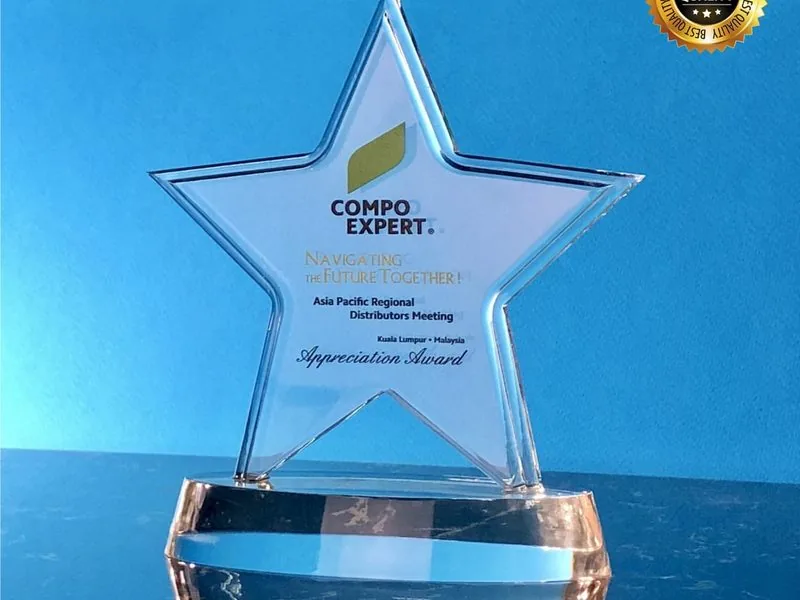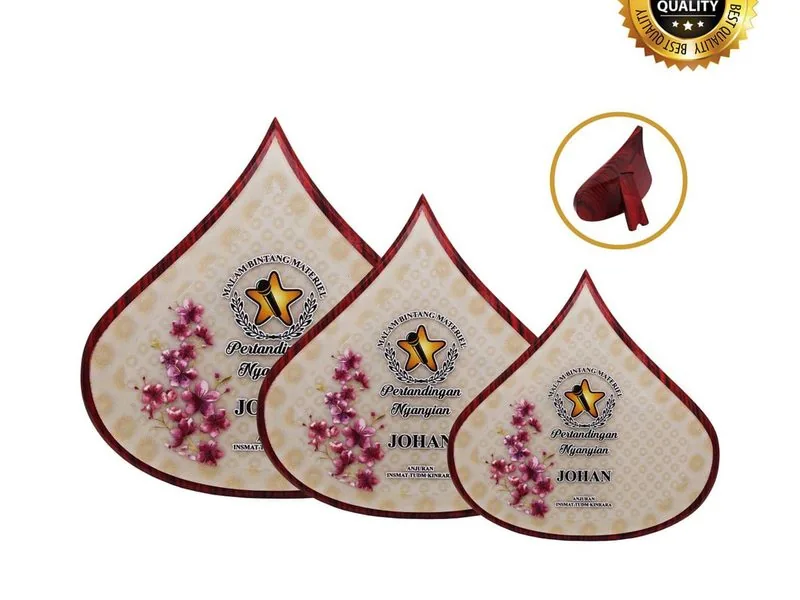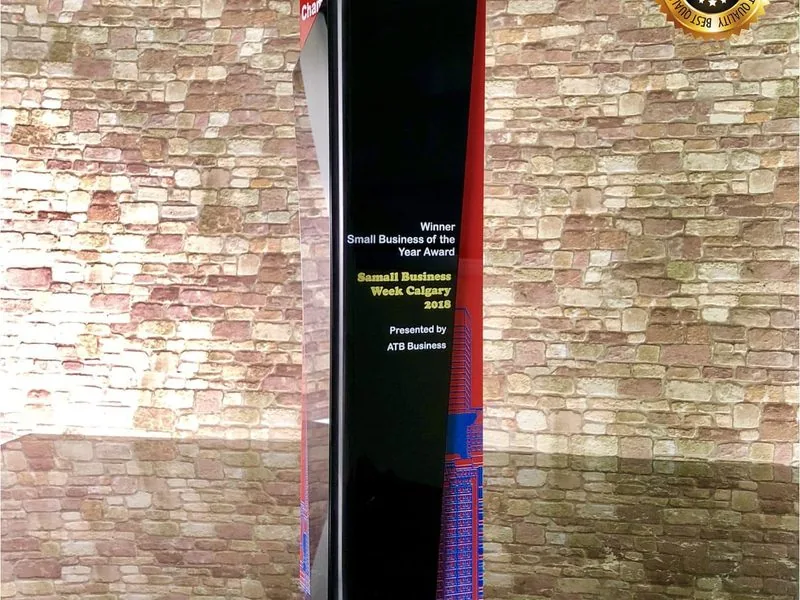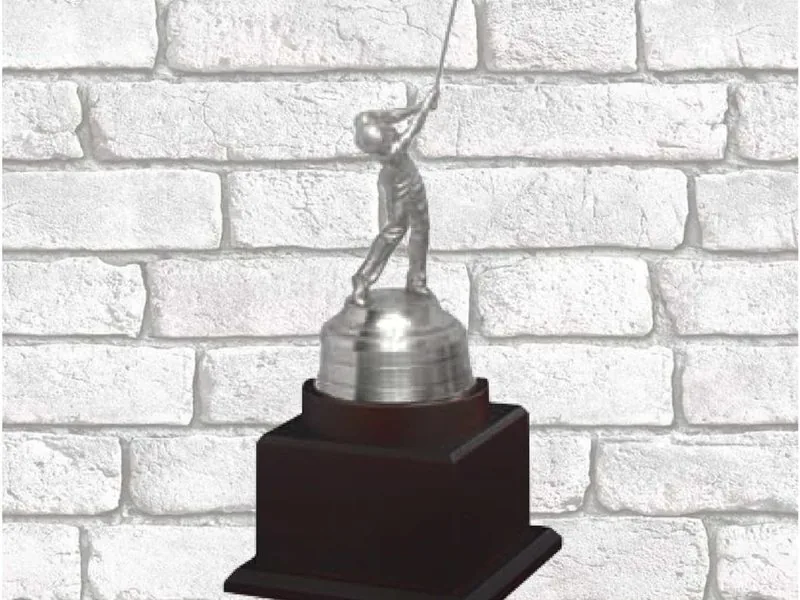
A tagline belongs on a trophy the way a director’s credit belongs on a film poster: present, but never bigger than the star. The star here is the recipient. Most tagline problems are really hierarchy problems, the company line creeping up in size until the person being honoured feels like a footnote in someone else’s advert.
The website rule is the opposite of the trophy rule. On a screen the tagline sells. On a trophy it just quietly says who gave the award. Marketing forwards the 56-character official line, and at 8pt on a crystal block it reads like a website footer while the recipient gets shrunk and lost.
Short answer: Keep the tagline under 30 characters, place it below the recipient name in a smaller, lighter weight (about 60-70% of the name’s size), and never above it. Going bilingual, remember Malay usually runs 20-30% longer than English, so mock both lines together. Then proof it letter by letter before sign-off, because “Excellence” and “Excellent” are one character apart and a full re-cut. Ask marketing for the short-form tagline from the email signature, not the long website version.
Why tagline placement is a hierarchy decision
Most buyers think of taglines as decoration. They’re not.
Every trophy has limited engravable real estate. A standard 200mm crystal block has roughly 60mm × 100mm of usable engraving area. A wooden plaque with a 6-inch metal plate has about 130mm × 90mm.
Within that frame, you have to fit:
- The recipient name
- The award title (e.g. “Long Service Award”, “Salesperson of the Year”)
- The year or date
- Optionally: the company name or logo
- Optionally: the corporate tagline
Add all of these without thinking about hierarchy and the trophy reads like a packed business card. Each element fights the others for visual attention. The recipient, the human being who actually receives the award, gets lost.
The discipline of trophy engraving is choosing what dominates. Almost always, the recipient name should dominate.
Everything else, including the tagline, plays a supporting role. If your tagline is fighting the recipient name for size, you’ve placed it wrong or sized it wrong.
The 6 steps in detail
The 30-character rule
The 30-character ceiling isn’t arbitrary. On a 200mm crystal block, a 30-character tagline at 11pt reads cleanly from arm’s length.
At 35-40 characters, the same font size starts to crowd. At 50+, you either shrink the font (now unreadable from row three) or wrap to two lines (now the trophy looks busy).
| Character count | Behaviour at 11pt on 200mm crystal | Verdict |
|---|---|---|
| Under 20 | Sits cleanly with breathing room | Ideal |
| 20-30 | Fits comfortably, single line | Safe |
| 30-40 | Starts crowding the recipient line | Marginal |
| 40-55 | Forces 9pt or a 2-line wrap | Avoid |
| 55+ | Illegible from across a banquet hall | Reject |
Common Malaysian corporate taglines in the under-30 range:
- “Trusted Since 1998” (18 chars)
- “Building Better Together” (24 chars)
- “Service Beyond Expectations” (28 chars)
These all fit cleanly under a recipient name with breathing room.
If your official tagline is longer, “Empowering Communities Through Innovation and Excellence” at 56 characters, pick a shorter alternate. Or use just a fragment (“Empowering Communities”, 22 chars).
Most marketing teams already have a “short version” of the tagline for letterheads and email signatures. Use that one.
Placement geometry
The default layout for a Malaysian corporate trophy with a tagline:
       [Company Logo]
   AWARD TITLE (e.g. LONG SERVICE AWARD)
            ─────────
       Recipient Name
       Datuk / Mr. / Ms., full honorifics
            ─────────
       In recognition of [n] years of service
            ─────────
       Corporate Tagline
            2026
The tagline sits low on the engraving, just above the year, in smaller font. This puts the visual centre of gravity on the recipient name, which is where it should be.
Avoid placing the tagline at the top of the engraving. We see this attempted on plaques where the company logo and tagline get stacked at the top.
It works for letterheads but reads as marketing on a trophy. The recipient feels like they’re on the receiving end of a brand campaign, not a personal recognition.
Font weight and size
Hierarchy comes from contrast in size, weight, and position. A working ratio for trophies:
- Award title: 16-18pt, bold or all caps
- Recipient name: 18-22pt, bold (the largest element)
- Citation copy: 11-13pt, regular weight
- Tagline: 10-12pt, regular or italic
- Year: 10-12pt, regular
The tagline should be the second-smallest element on the engraving, larger only than fine print like serial numbers.
If you’re tempted to make the tagline bold or larger to “make it stand out”, resist. The tagline is meant to be a quiet credit, not a banner.
Font family matters too. If the recipient name is engraved in a clean serif (Times, Garamond, Trajan), keep the tagline in the same family.
Mixing a serif name with a sans-serif tagline is a common amateur move. It makes the trophy look designed by committee.
Bilingual layouts (English + Bahasa Malaysia)
Many Malaysian corporate trophies carry both English and Bahasa Malaysia, banks, GLCs, and statutory bodies almost always do. Bilingual taglines have specific traps that monolingual ones don’t.
Length difference. Malay phrases are typically 20-30% longer than the English equivalent. Examples:
- “Excellence in Service” (21) → “Kecemerlangan dalam Perkhidmatan” (32)
- “Trusted Partner” (15) → “Rakan Kongsi Yang Dipercayai” (28)
- “Innovation Leader” (17) → “Peneraju Inovasi” (16), sometimes shorter, but not often
When you proof a bilingual tagline, mock up both languages together. The English line might fit cleanly while the BM line wraps awkwardly. The fix is usually a shorter Malay equivalent. Or accept a smaller font for the BM line.
Layout pattern. The two languages are usually stacked, with English on top and BM below, separated by a thin divider line or extra spacing. Don’t put one language on the left and the other on the right. It reads like a translation table.
Diacritics. Bahasa Malaysia in formal corporate use rarely needs diacritics, but check honorifics. “Tan Sri Datuk Seri” should be exact.
For BM standards, Dewan Bahasa dan Pustaka (DBP) is the official authority. Useful when settling internal disagreements about formal Malay phrasing.
Tamil and Mandarin trophies have their own typography rules. See bilingual engraving in Bahasa Malaysia, Mandarin and Tamil trophy engraving, and our multilingual engraving guide.
Proofing letter by letter
The single most common failure point: skim-reading the proof. A 25-character tagline takes 4 seconds to read at normal speed.
Letter-by-letter proofing takes 30 seconds. Those extra 26 seconds catch every error that would otherwise reach production.
Errors we see most often on tagline proofs:
- Apostrophe drift. “We’re committed” becomes “Were committed” when the apostrophe gets dropped during file conversion.
- Capitalisation inconsistency. “CEO” vs “Ceo”, “ICT” vs “Ict”, usually the result of auto-formatting on the source document.
- Single-letter swaps. “Acheivement” vs “Achievement”, “Independant” vs “Independent”. Spell-check sometimes flags these in Word but not in the proof file.
- Trailing periods or commas. Some buyers want them, some don’t. Whichever you choose, be consistent across all pieces in a multi-recipient order.
Signing off in writing
The proof is a contract. Reply “approved” on WhatsApp only after you’ve done the letter-by-letter check.
We’ve had buyers approve, then call back two hours later asking to change a word. Sometimes we can stop production. Sometimes the partner workshop has already cut.
The earlier in the day you sign off, the more flexibility there is for last-minute catches.
For multi-recipient orders, sign off on the entire batch at once after reviewing every individual proof. Don’t approve in dribs and drabs over three days. It’s a coordination nightmare and increases the chance of mismatched batches.
Short taglines that engrave beautifully
The corporate trophy taglines that have read cleanest across our partner workshops in 2025-2026:
- Banking sector: “Trusted Since 1965” (18 chars), “Banking on Tomorrow” (18 chars), “Beyond Banking” (14 chars)
- Insurance sector: “Protecting What Matters” (23 chars), “Promises Kept” (13 chars)
- Manufacturing: “Built to Last” (13 chars), “Engineering Excellence” (22 chars)
- Retail/FMCG: “Closer to You” (13 chars), “Made in Malaysia” (16 chars)
- Tech/telco: “Connecting Malaysia” (19 chars), “Faster. Smarter. Closer.” (24 chars)
What makes these work: short, punchy, no buzzwords, no superlatives.
A tagline that reads like a Tweet usually engraves like a tagline. A tagline that reads like a press release usually engraves like a footer.
What to avoid: “Industry-Leading Solutions for the Modern Enterprise”. Even if your marketing team approved this for the website, it doesn’t belong on a trophy. The recipient sees buzzwords, not recognition.
Bilingual layout considerations
When stacking English and Bahasa Malaysia taglines, the standard pattern in Malaysian corporate trophies is:
       Recipient Name
       ─────────
   English Tagline
   Tagline Bahasa Malaysia
       ─────────
            2026
The two lines should be the same font size, same weight, same alignment. The thin divider above and below visually groups them as one element rather than two competing lines.
If your tagline is significantly longer in BM, you have three options:
- Shrink the BM line to 90% of the English line size (subtle, usually works)
- Pick a shorter BM equivalent that conveys the same meaning
- Skip the BM tagline and let the English carry it
Option 3 is fine for trophies given to senior leaders who work primarily in English, less appropriate for trophies given to staff at a multilingual ceremony.
Common tagline mistakes
Mistake 1: Reusing the website tagline verbatim. Website taglines are written for screens viewed in milliseconds. Trophy taglines are read for years on a desk and photographed under stage spotlights. Different media, different rules.
Mistake 2: Adding the year inside the tagline. “Building Better Together, 2026” makes the tagline date-stamped. Next year you’ll need a different one. Keep the year as a separate element below the tagline.
Mistake 3: Three-line taglines. Two lines is the maximum for a trophy. Three lines reads as a paragraph and breaks the visual hierarchy.
Mistake 4: Using a tagline only on some trophies in a batch. If you’re ordering 12 long-service awards, all 12 should have the same tagline (or none). Mixing creates inconsistency. Recipients notice when they compare trophies at the dinner.
Mistake 5: Mixing tagline and subtitle. Some buyers add both a tagline (“Excellence in Service”) and a citation subtitle (“In recognition of 20 years of dedicated service”). Pick one. Both crowds the engraving.
The 60-second tagline-to-trophy test
Before you sign off, do this once. Print the proof at 100% on plain A4. Pin it to a wall.
Stand 4 metres back, roughly the distance from the front row to a podium at most KL banquet venues. Read every line aloud.
If you stumble on the tagline, it’s too small or too long. If your eye lands on the tagline before the recipient’s name, the hierarchy is wrong. Fix it on paper, not on crystal.
For tagline mock-ups across crystal, acrylic, wood, and pewter, message us on WhatsApp at +60 12-213 6631.
Next step. Ask your marketing team for the official short-form tagline (every brand book has one, the one on email signatures and letterheads). Count characters. Under 30, send it with the recipient list. Over 30, ask for the shortest sanctioned variant or use the first three words. WhatsApp us with the trophy spec and we’ll return long-and-short versions side-by-side within the working day. Browse the crystal trophies range for tagline-friendly formats, and see the corporate awards Malaysia guide, the custom trophy Malaysia guide, and Best Engraving Fonts for Trophies.
We've engraved 'Building Tomorrow Together' on hundreds of pieces. We've also engraved 'Buidling Tomorrow Together' once. Guess which one cost the workshop a re-cut.