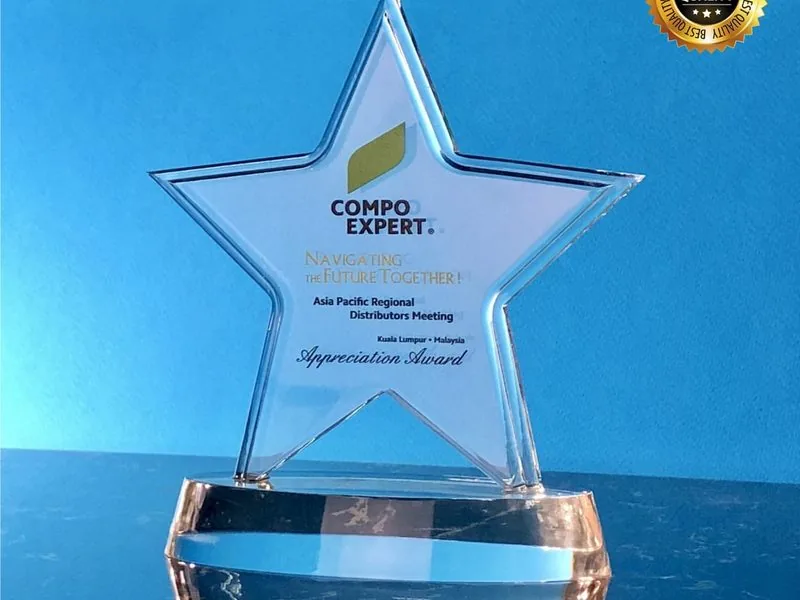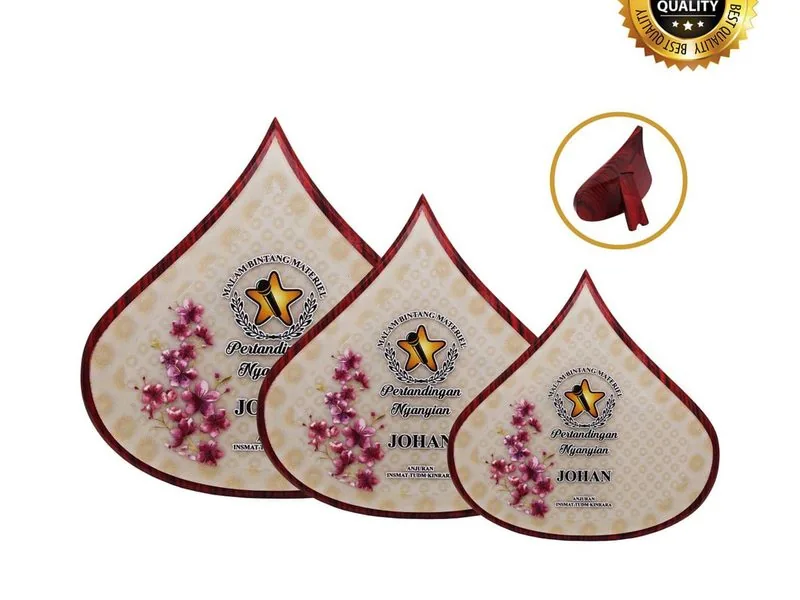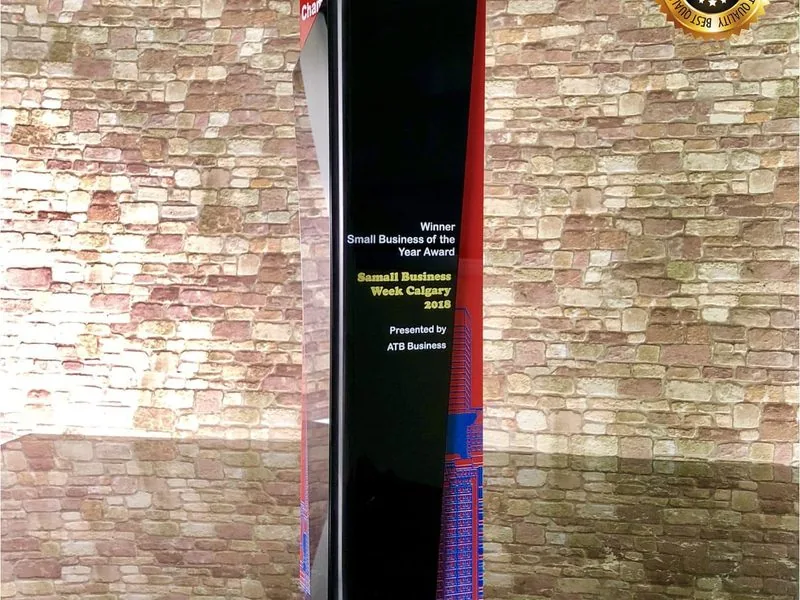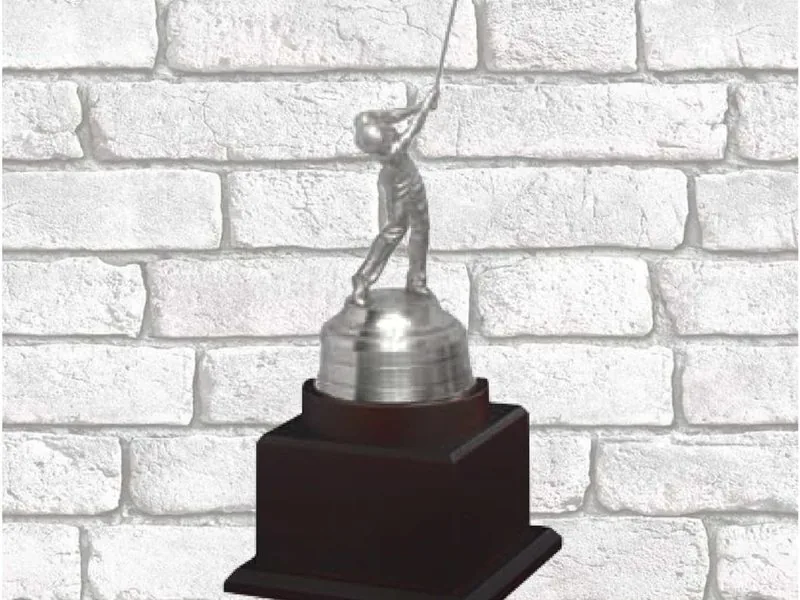
A multilingual trophy is rarely ruined by the engraving. It’s ruined in the brief, before anyone touches a laser. Send the Mandarin as romanised pinyin instead of the actual characters, or let the font quietly fall back, and the piece comes out wrong even though every word is spelled correctly.
The good news: it’s a workflow, not a typography puzzle. Get the right text in the right script, check it with someone who reads that language, and the layout falls into place. Once a crystal is cut, there’s no editing it, so the whole job is really about getting the proof right.
Short answer: Match the language to the audience, not your preference. Source every line in its real script (Mandarin characters, Tamil script, Jawi), never romanised. Pick a font that genuinely covers each script so nothing sits heavier than the line beside it. Have a native speaker read every line on the proof before you sign off in writing. Below is the six-step process I run on every multilingual order.
Step 1: Match language choice to the actual audience in the room
Language choice should follow the audience, not the designer’s preference. Before you write a word of engraving copy, get clear on who is going to read this trophy, at the ceremony and on the shelf afterwards.
Working defaults from supplying Malaysian corporate clients:
| Context | Default language combination |
|---|---|
| Corporate KL events, mixed audience | English (safe) or English + BM (respectful upgrade) |
| Government-linked events / GLCs | BM primary, English secondary; Jawi on royal-patronage or religious pieces |
| Banks, insurers, public-listed companies | English-only on most pieces |
| MNCs (US, EU, Japan, Korea parent) | English-only by default; bilingual for senior locally-rooted leadership |
| Malaysian conglomerates | English + BM bilingual, BM often secondary |
| National schools, tertiary | BM primary; English + BM for international schools and private universities |
| SJK(C) | Mandarin + BM (or English) |
| SJK(T) | Tamil + BM (or English) |
| Religious / community awards | Language of the community: Jawi for Islamic institutions; Mandarin for Chinese clan associations; Tamil for Hindu temple awards |
Once you’ve nailed the audience, the language choice is usually obvious.
Where it’s not, default to English-only and add a short BM line at the bottom. That combination almost never feels wrong in a Malaysian corporate setting.
Step 2: Source the text in the correct script
This is where most multilingual engraving jobs go off the rails before they even start.
If your trophy is going to carry Mandarin, the engraving brief must include the text in Mandarin characters. Not pinyin, not romanised approximation.
If the trophy is going to carry Tamil, send Tamil script. If it’s going to carry Jawi, send Jawi.
Why this matters:
- Romanised Mandarin (pinyin) on a trophy looks unprofessional. A trophy that says “Zui Jia Yuan Gong” instead of 最佳員工 reads as “we couldn’t be bothered to get the actual characters.” It happens often when an admin team types from voice and doesn’t have a Chinese keyboard handy.
- Romanised Tamil is similarly weak. Tamil script is part of the cultural register. Without it, the gesture loses meaning.
- Jawi cannot be approximated in Latin script at all. Either you have the Jawi characters or you don’t engrave Jawi.
How to source the text:
- For Mandarin: ask a native speaker on your team to type it directly. Most Chinese-speaking Malaysians can switch to a Mandarin keyboard on their phone within seconds. If you don’t have a native speaker, tell us and we’ll route it through our translation contacts for a small fee.
- For Tamil: same. Have a native speaker type it. Tamil-typing apps on phones are widely available.
- For Jawi: Jawi conversion is more specialised. Dewan Bahasa dan Pustaka (DBP) is the official authority for both Jawi and formal Bahasa Malaysia. Several university Jawi departments (UM, UIAM) can help with conversion of proper nouns. Plan for an extra day to source.
- For BM: if the BM text is straightforward (a recipient citation), you can write it yourself. For ceremonial phrasing, anugerah, penghargaan, perkhidmatan cemerlang, get someone fluent in formal BM to draft and review. The DBP PRPM online dictionary is the corporate-Malaysia standard reference.
Send the script as Unicode text in your WhatsApp message or email, not as a screenshot.
Unicode text can be copied directly into the engraving file. A screenshot has to be re-typed by the supplier, a step where errors creep in.
Step 3: Choose a layout (stacked, side-by-side, or primary+secondary)
With audience and text settled, layout is the next call. Three working patterns:
Stacked layout. One language above the other, both centred, both given roughly equal visual weight. Works well on tall plaques and crystal pieces with vertical face area.
Common pattern: English headline at the top, recipient name in the middle (often single language for clarity), BM citation at the bottom. The stacked layout reads as bilingually-equal. That’s the right register for GLCs, public events, and anything that wants to be seen as serving both communities.
Side-by-side layout. Two languages on left and right of the plate, separated by a thin divider or generous white space. Works on wide horizontal plates, typical wooden citation plaques (200 mm × 150 mm or larger), wide acrylic awards.
The side-by-side layout suits longer citations where each language gets its own paragraph. Be careful with line lengths.
Mandarin is usually shorter than English in character count. BM is sometimes longer. Don’t squeeze. Let the side-by-side breathe.
Primary+secondary layout. One language is dominant, bigger, central, the focus of the piece. The other appears as a small secondary line, often at the bottom. Works when you have a clear primary language but want to acknowledge a second.
Common pattern: English headline and recipient name in the body, with a small BM “Anugerah Perkhidmatan Cemerlang” strap at the bottom. The piece reads as English-led with a respectful BM nod. Fits many corporate-KL contexts.
Choose layout based on:
- Available real estate on the trophy face. Crystal pieces are usually narrower. Wood and acrylic plaques are wider.
- Length of each language version. Mandarin is compact. BM tends to be slightly longer than English. Tamil sits in the middle.
- Audience expectation. Government events often expect BM-primary or fully balanced bilingual. Corporate-MNC events often expect English-primary.
- Aesthetic. Side-by-side has a formal, document-like feel. Stacked has a balanced, ceremonial feel. Primary+secondary has a clean, modern feel.
Step 4: Pick a font that genuinely covers every required script
We’ve covered font selection in detail in our engraving font guide, but for multilingual jobs the script-coverage check becomes load-bearing. The matrix below is what we run on every multilingual brief:
| Combination | Safe pairing | Trap |
|---|---|---|
| English + BM | Trajan Pro / Optima / Cormorant / Garamond / Inter / Avenir | Display fonts that skip Malay diacritics |
| English + Mandarin | Source Han Serif + Source Han Serif CN, or Noto Serif + Noto Serif CJK SC | Times / Helvetica CJK fallbacks render at wrong proportion |
| English + Tamil | Noto Sans + Noto Sans Tamil, or any Latin font + Latha | Bespoke display fonts almost never include Tamil |
| English + Jawi | Latin font + Noto Naskh Arabic with Jawi glyph extensions | Jawi reads right-to-left, layouts must mirror |
| 3-4 scripts on one piece | Noto super-family or Source Han across all scripts | Mix-and-match families produce visible weight mismatch |
Don’t use Times New Roman or Helvetica for Mandarin. These fonts do contain CJK glyphs in some operating systems but the proportions are usually off. The Mandarin ends up looking heavier or lighter than the English next to it.
Practical detail: when sending your engraving brief to the supplier, specify the font for each script. “English in Trajan Pro 18pt, Mandarin in Source Han Serif 18pt” is a clear brief. “Use a nice serif font” is not.
Step 5: Get a native speaker to read every line aloud
This is the step buyers most often skip, and it’s the most expensive one to skip. A 5-minute native review prevents a 5-week regret.
AI translation tools, Google Translate, ChatGPT, DeepL, are excellent for everyday vocabulary. They are not reliable for ceremonial register, honorifics, formal phrasing, or idiomatic ceremony language.
A few real failure modes we’ve seen:
- Mandarin honorifics. “退休纪念” (retirement memorial) vs “荣休纪念” (honourable retirement memorial), same English translation, very different register. AI tools default to the simpler form, which reads as cheap on a long-service award.
- Tamil formal address. AI tools sometimes drop the polite suffix, leaving the citation in everyday rather than ceremonial register.
- Jawi spelling. Modern Jawi has standardised spelling rules but AI tools often produce variant spellings, particularly for proper nouns. Native review catches this immediately.
- BM ceremonial phrasing. “Anugerah Perkhidmatan Cemerlang” vs “Anugerah Khidmat Cemerlang”, both grammatically correct. Corporate Malaysia has settled conventions around which phrase fits which context. AI tools don’t know these conventions.
The discipline:
- Mandarin proof: have a Mandarin-fluent colleague read it aloud. They will spot register and honorific issues in seconds.
- Tamil proof: same, Tamil-fluent reviewer.
- Jawi proof: Jawi reviewers are rarer. Government-related awards may have a designated Jawi-fluent person internally. If not, ask the supplier to route through their translation contact.
- BM proof: have someone fluent in formal BM read it. Day-to-day BM and ceremonial BM are not the same register.
Five minutes of native review prevents the situation where a senior Mandarin-speaking recipient reads their long-service award and notices the wrong honorific. Once read, that’s permanent.
Step 6: Sign off in writing on the final proof
The final step mirrors any engraving job: confirm in writing, in full, before production starts.
For multilingual jobs, the sign-off has more lines to check. The discipline:
- Read the entire proof aloud in each language. Not skim, read.
- Have the native reviewer for each language do the final check. Each language gets its own pass.
- Confirm in writing on WhatsApp or email. Use the order reference number, the recipient name, and a clear “approved for production” message.
- Take 24 hours if any language feels unfamiliar. Wait, recheck, then approve.
For complex multilingual orders, say, four languages on twelve plaques for an institutional event, we recommend a same-day walk-in to our Brem Park, Kuchai Lama showroom.
Bring the native-speaker reviewer with you. We run through every plaque on screen, line by line, with the reviewer doing the final reading. WhatsApp +60 12-213 6631 to book a slot.
Once approved, production starts within hours. Crystal cannot be re-engraved. Wood can sometimes be re-routed at extra cost. Pewter shows ghost marks if re-etched.
The proof step is the cheapest insurance you have.
The quiet failure nobody checks for
The costliest multilingual mistake isn’t a typo. It’s a font substitution, and it slips past everyone because every word is spelled correctly.
Here’s how it happens. The brief says “English and Mandarin” but doesn’t name a font for the Mandarin. The designer’s software fills the gap with a default CJK fallback. Both lines are legible. Both are correct.
But the fallback sits heavier than the English at the same point size, so the Mandarin reads as the dominant line on every piece. Nobody approved that hierarchy. It just emerged from a substitution no one caught on screen.
The fix costs nothing. Name the font for each script in the brief, in writing, before sign-off. “Source Han Serif for Mandarin” closes off this whole category of failure.
Next step. WhatsApp me at +60 12-213 6631 with four things: the recipient list with each name in the script you want engraved, the language combination per piece, the ceremony date, and any brand font files you’d like me to consider. I’ll send back a layout proof and a font matrix per piece within one working day. For a complex job, bring your native-speaker reviewer to the Brem Park showroom and we’ll sign off line by line.
Browse the crystal trophies range for formats, and see the bilingual and multi-script engraving guide for script-by-script detail. For wording and broader programs, the corporate awards, custom trophy, and Anugerah Perkhidmatan Cemerlang guides cover it, and the process page walks through the full quote-to-dispatch flow.
If the language wasn't on the proof, it isn't on the trophy. Decide early, write it once, sign it off in writing.