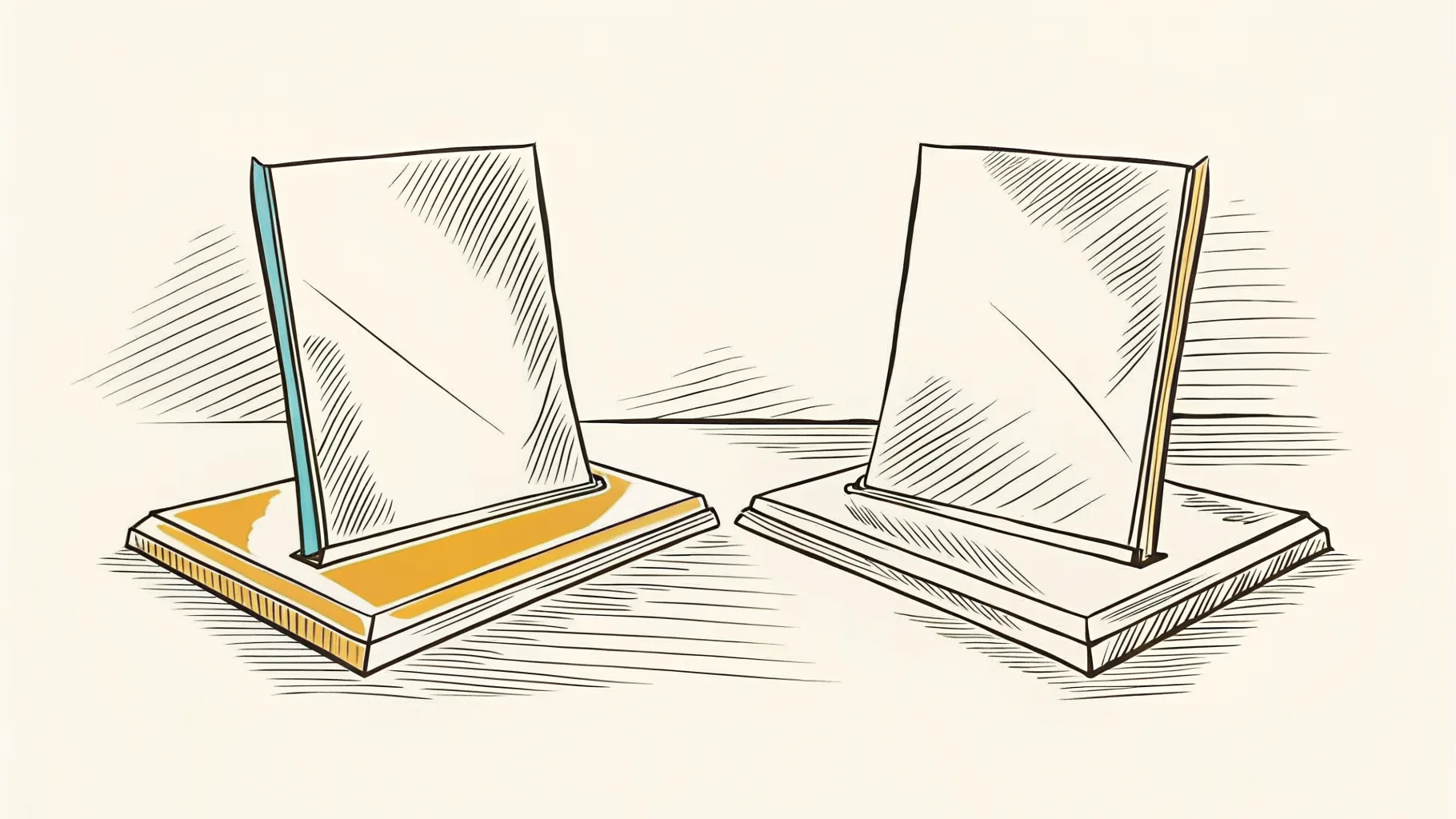
Two pieces, identical. That’s the structural rule an MOU plaque starts from. Legal files the document, comms posts the press release, and the two plaques on each CEO’s wall are the only thing anyone still sees years later, quietly photographed in every executive interview and annual-report shot.
That’s why the format matters. This covers the paired-pieces convention, the brand-symmetry protocol that makes or breaks the gesture diplomatically, the citation that names both parties at equal weight, and the signing-day logistics that lock in the photo.
Short answer: Commission identical matching pairs, one per party, in a premium material that ages well (brass on hardwood, optical crystal, or pewter). Place both brands at strictly equal size and colour, name both parties at equal weight in the citation with the specific subject and date, and present the pieces at the signing for the photograph. Brief 6–8 weeks ahead, longer for custom or pewter work.

What makes MOU plaques different
Three things set them apart from internal recognition pieces.
They’re paired and identical. Most MOU plaques come in matching pairs, one for each signing party, with a citation that names both parties at equal prominence. A consortium of three to five organisations gets one identical plaque each, sometimes plus a ceremonial centrepiece.
They’re seen at the ceremony. The plaques are present at the signing and photographed with both signatories holding identical pieces side by side. The format has to read well at stage scale and at thumbnail size in a printed press release.
They live on executive walls for years. Durability matters, and a design tied to one fashion cycle ages badly. All of which pushes MOU plaques toward premium materials, conservative design, equal brand placement, and brand-accurate logo reproduction.
Standard MOU plaque formats
| Format | Register | Best for |
|---|---|---|
| Brass plate on hardwood | Conservative, heritage | Strategic alliances, state-government MOUs |
| Optical crystal with inner-laser engraving | Modern, premium | Tech, fintech, brand-conscious corporates |
| Pewter plate with cultural motif | Heritage Malaysian | Government MOUs, GLC partnerships |
| Custom-mould commission | Founder-tier, defining | The relationship that anchors a business |
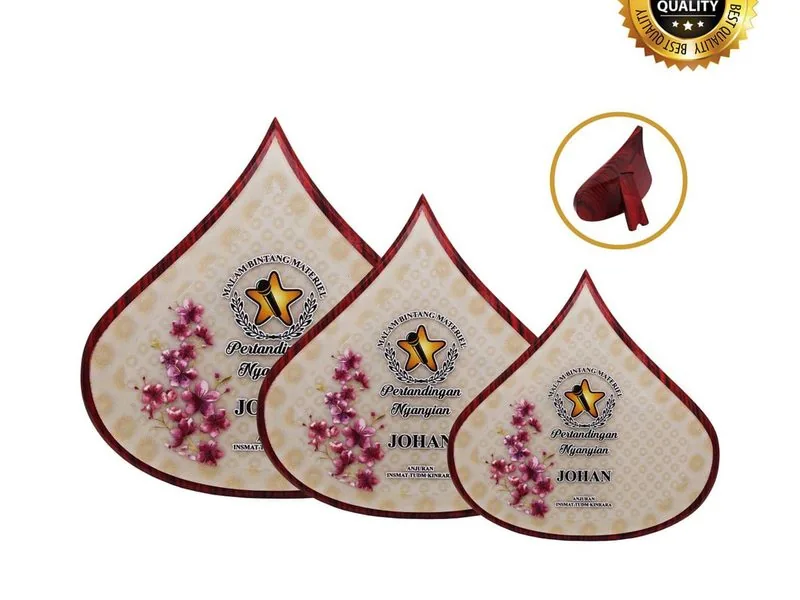
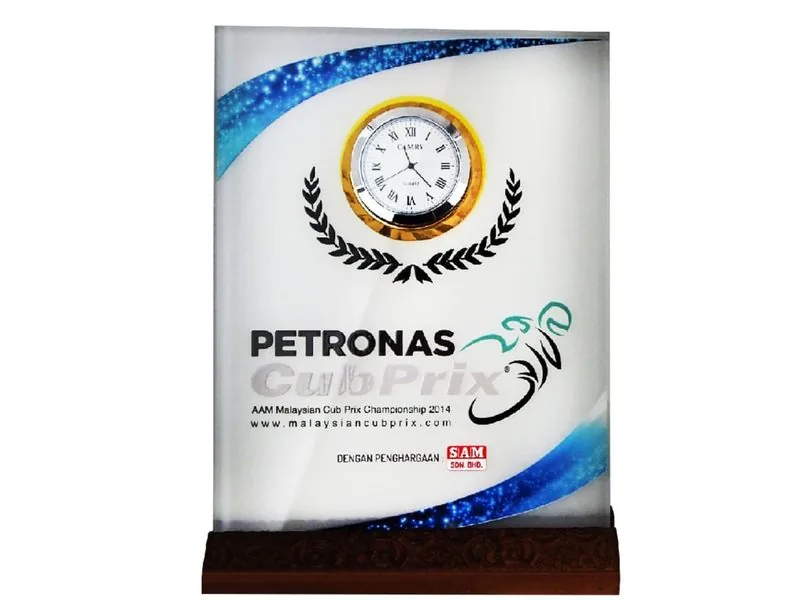
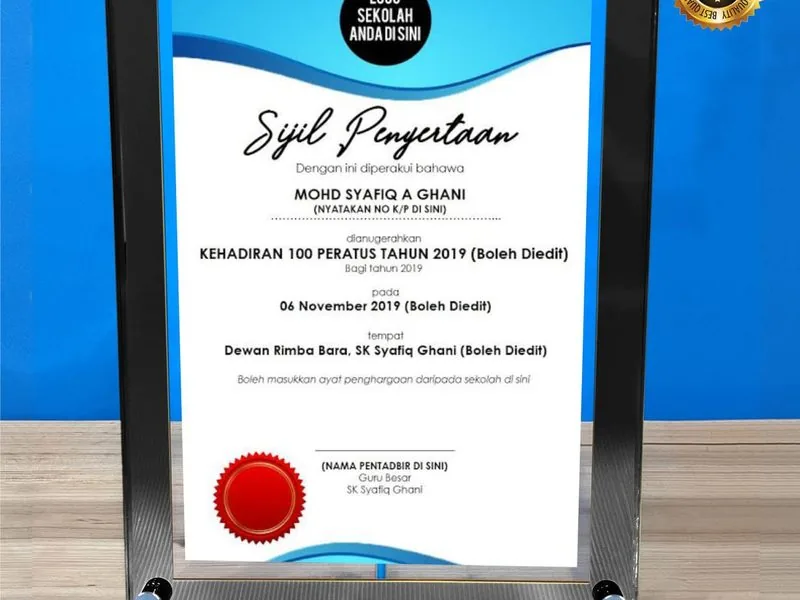
Brass-on-hardwood is the most traditional: a walnut-stained or teak plaque with an engraved brass nameplate, in a velvet-lined case. It photographs well at boardroom scale and ages without dating. Wood carries the 10× MOQ, but a matching pair clears that easily. Crystal reads modern-premium and takes full-colour UV print for brand-accurate logos. Pewter carries a heritage register that nothing else quite matches for senior Malay-Muslim signatories.
Standard brass and crystal pairs run from a few hundred to a couple of thousand ringgit a piece; pewter and custom-mould commissions are bespoke and priced case-by-case, so WhatsApp us for a quote. For the decoration-method call between engraving and full-colour UV print, see acrylic UV print vs laser engraving, and for pewter, the pewter trophies buyers guide. Browse wooden plaques for the traditional format.
Citation conventions
The citation names both parties prominently, which is what separates an MOU plaque from any internal piece. A standard pattern:
PARTNERSHIP RECOGNITION
or MEMORANDUM OF UNDERSTANDING

[Party A — name and logo]
[Party B — name and logo]

"For collaboration on [specific subject area],
beginning [date] for [duration],
to advance [shared goal]."

[Signing date] · [Venue]
For a strategic alliance with named signatories:
STRATEGIC PARTNERSHIP
[Party A] · [Party B]

In recognition of the alliance signed on [date]
at [venue], formalising collaboration on
[subject area].

Signed by:
[Name, Position, Party A]
[Name, Position, Party B]
The specificity is the value. “In recognition of partnership” misses the moment; “for collaboration on AI-driven credit scoring, 2027–2032” lands it. For more wording, see the appreciation plaque wording examples.
Equal brand placement is non-negotiable
This is where MOU plaques fail diplomatically, when one party’s logo is even slightly larger than the other’s. Treat it as a strict protocol, not a design preference.
| Element | Required treatment | If you get it wrong |
|---|---|---|
| Logo placement | Both logos equal size, side-by-side or stacked by agreed order | Asymmetry reads as a power imbalance |
| Logo sizing | Strict equality, measured before production | A size variance gets the piece quietly recalled |
| Brand colour | Brand-accurate for both (UV print where colour matters) | Off-brand colour reads as carelessness |
| Logo files | Vector from each party’s brand team, no JPG/PNG | Soft, fuzzy reproduction at scale |
| Naming order | Alphabetical or host-first, agreed in writing | Implied hierarchy and bruised feelings |
On material and colour: brass engraving is single-tone (gold, silver, bronze), which works when both brands read in mono. Crystal with UV print gives full brand-accurate colour, the default for modern brand-conscious corporates. Pewter takes a single-tone engraved logo, which suits heritage corporate brands whose identity reads even in one tone.
Presenting at the signing
The plaques are presented at the ceremony itself, usually in this order: the document signing, the document exchange, then the plaque exchange (each signatory hands the matching plaque to their counterpart), the group photo, and the speeches. Stage both pieces on a display table beside the signing table, engraved face out, visible to the audience throughout. Brief the photographer on lighting, especially for crystal. Skip the signing-day presentation and the plaque becomes an executive-wall ornament without provenance, which defeats the spend.
Five mistakes that signal carelessness
- A single plaque instead of a pair. One party gets the artefact, the other gets the press release. It’s noticed within a day and remembered for years.
- A different format for each party “to match each brand”. Looks bespoke in the brief, looks unrelated on the stage. Same format, both brands integrated equally, every time.
- A generic citation. Use the specific subject, duration, and signatories. Specificity is the value.
- Briefing at T-2 weeks. You’ll get stock pieces, weak brand integration, and a coin-flip on arrival. Premium-tier MOUs need 6–8 weeks; custom-mould needs longer.
- Skipping the signing-day photo. The piece is meant to be photographed with both signatories at the ceremony, side by side, identical pieces in hand.
Brief us
WhatsApp +60 12-213 6631 with both official party names and vector logos, the MOU subject in a line or two, the signing date and venue, a format direction, the quantity (usually two), and any confidentiality needs. Design and revisions are free; you pay for the pieces and courier. For premium pieces, a visit to our Brem Park showroom to brief at the design bench is worth it. For sister formats, see the chairman/CEO award format, and for the wider picture, the corporate awards Malaysia guide.
An MOU plaque is a long-running billboard on the partner CEO's wall. Spend the budget the partnership deserves, and get the brand symmetry exactly right.