The brief matters more than the budget. Send me three to five reference images first, even from other industries, and you’ll have a route recommendation by close of business. Send “we want something premium” and you’ve started the wrong conversation, because I’ve got nothing to design against.
Here’s the thing first-timers get backwards: the right silhouette at a modest acrylic price beats a generic imported crystal every time, and a custom mould you regret the moment it’s cast is the most expensive trophy purchase you’ll ever make. The whole game is getting the design right before any money is spent on tooling.
So here are the six structured steps almost no first-time buyer takes seriously enough, the playbook I walk every corporate, university, association and event buyer through from Brem Park. For the wider ground, see custom trophy Malaysia, corporate awards Malaysia, and browse base shapes in crystal trophies and acrylic trophies.
Buyer answer block: custom trophy route, budget, lead time
For Malaysia custom trophy orders, choose acrylic CNC when you need a custom silhouette in 1-2 weeks, custom-sourced crystal when you need a premium 5-50 piece executive run in 2-4 weeks, and custom mould only when you have 50+ pieces or a repeat annual design with 4-6 weeks available.
| Buyer question | Practical answer | Route to ask for | Quantity / RM threshold |
|---|---|---|---|
| ”Can I customise under 2 weeks?” | Yes, if the artwork is ready and proof is approved same day | Acrylic CNC or stock crystal/acrylic with engraving | Best for 1-50 pcs; keep scope simple |
| ”Can I stay below RM150 per piece?” | Usually use stock trophies plus free engraving, not a bespoke shape | Stock acrylic, metal or crystal | Entry recognition, school or mass staff pieces |
| ”What if budget is RM150-400 per piece?” | Use stock crystal/acrylic or a simple CNC acrylic silhouette | Stock + custom engraving, or acrylic CNC | Good for 10-100 pcs |
| ”What if budget is RM400-1,200 per piece?” | Premium crystal, thicker acrylic, pewter detail or hybrid construction becomes realistic | Crystal, acrylic, pewter hybrid | Senior corporate awards and hero tiers |
| ”When does custom mould make sense?” | When tooling can be spread across volume or reused next year | Resin/metal custom mould | 50+ pcs or recurring annual programme |
Use the trophy budget calculator if you need a first RM bracket before briefing, then send the final scope through the process page or WhatsApp. For category context, the pricing guide is the cleanest cross-check against the material tiers below.
When bespoke pays off, and when stock with custom engraving wins
Bespoke is not always the right answer. I say this even though I’d happily quote you on either path. The rough decision matrix I use:
Bespoke makes sense when:
- Unit budget is genuinely premium, not entry-level
- The award has a multi-year life (perpetual cup, founder series, anniversary milestone)
- The brand or category itself is the story, a property developer’s “Building of the Year”, a TV station’s flagship award, an industry association’s annual gold medal
- Quantities are either very low (1-3 hero pieces) or large enough to amortise tooling (50+ for a custom mould)
Stock shape with custom engraving makes sense when:
- The budget is entry to mid-tier
- Lead time is under 2 weeks
- The trophy is one of many across multiple tiers and categories at a yearly dinner, your “Top Performer Q1” doesn’t need a unique sculpt
If you’re somewhere in the middle (mid-budget, 10-30 units, a 3-week lead time), the answer is usually a stock crystal blank with a custom engraved logo or 2D etched design. That’s not really “bespoke”, that’s just custom engraving, which is free at iTrophy regardless. For everything else, the six-step process below applies.
Step 1, The concept brief
The brief is where most custom-trophy projects go right or wrong. I’ve seen briefs that were a single line on WhatsApp (“hi, custom trophy for our annual dinner, 50 pcs, before 30 June, can?”) and I’ve seen briefs that came as a 14-page PowerPoint. Both can work. What the good ones have in common is four pieces of information.
Reference images. Pinterest screenshots, photos of trophies you’ve received in the past, a competitor’s award, a sketch on tissue paper. Anything visual. We can read CAD files, vector illustrations, hand drawings. You don’t need a designer on your team, just show us a direction.
Target quantity. This is the single biggest cost driver on a custom mould. The same design at 20 pcs versus 200 pcs has wildly different unit economics, because the tooling cost gets amortised over the run. Always give us a quantity, even if it’s a rough range.
Target unit price band. Don’t be shy. I’d rather know what you’re aiming for than design a piece you can’t afford. The honest brief gets the honest quote, every time.
The story. Two sentences are enough. “This is for our top regional sales rep, awarded once a year, perpetual cup with annual nameplates.” Or “anniversary award for our 10-year, 15-year, 20-year long-service staff, three tiers, ceremony in November.” The story shapes the silhouette, the material, and the engraving format.
Send the four things to WhatsApp +60 12-213 6631 and we’ll come back with a route recommendation, a real RM band, and a calendar. Get the brief right and the next five steps stay on track.
Step 2, Pick the right design route (CNC / mould / crystal)
There are three distinct routes for a bespoke trophy in Malaysia. Each has its own cost curve, lead time, and design constraints. Choosing the wrong route is the most common reason custom projects blow their budget. Because every bespoke piece is quoted to its own spec, I’ve given the route economics in relative terms here, the real number comes back once I’ve seen your brief.
| Route | Lead time | Pricing | Tooling | Quantity sweet spot | Best for |
|---|---|---|---|---|---|
| Custom acrylic CNC | 1-2 weeks | Most accessible, quoted per piece | None | 10-200 pcs, small runs viable | Annual dinner, sales recognition, anniversary plaques |
| Custom mould (resin/metal) | 4-6 weeks | Quoted on spec; tooling only pays off at volume | One-off, quoted | 50-500 pcs | Perpetual cups, multi-year league, association flagships |
| Custom-sourced crystal | 2-4 weeks | Premium, quoted on spec | None | 5-50 pcs | Chairman/CEO awards, IPO commemoratives, hero pieces |
| Hybrid (crystal + pewter + wood) | 3-5 weeks | Quoted on spec | Variable | 1-10 pcs | Founder anniversary, lifetime achievement |
All prices SST-inclusive and quoted to the brief. Wood components add a 10x MOQ and about 1 extra week to any route they appear in.
Artwork formats that keep the quote moving: send vector logo files first (.ai, .eps, .svg, vector .pdf). A transparent 300dpi PNG at 1500px+ wide is workable for UV print and laser marking. JPG, phone photos and screenshots are usable for direction, but they often add 1 working day for redraw or vector rebuild.
Route A: Custom acrylic CNC
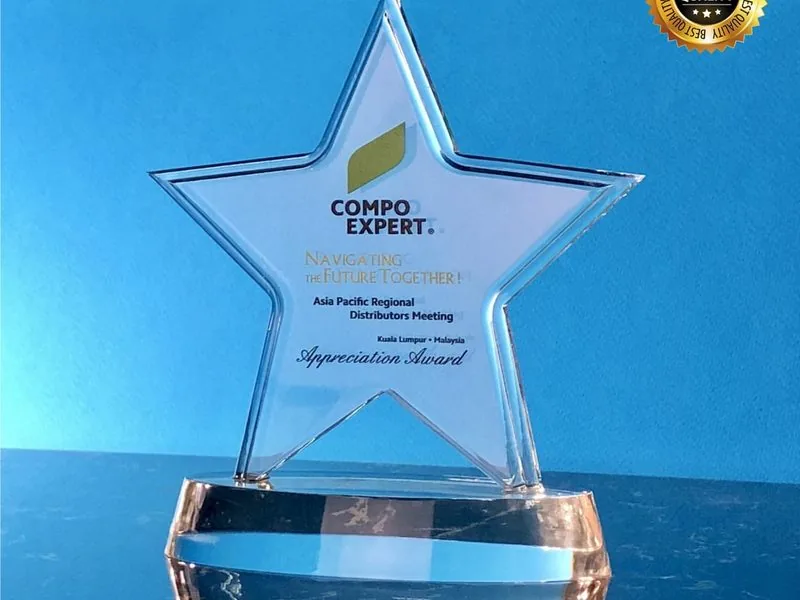
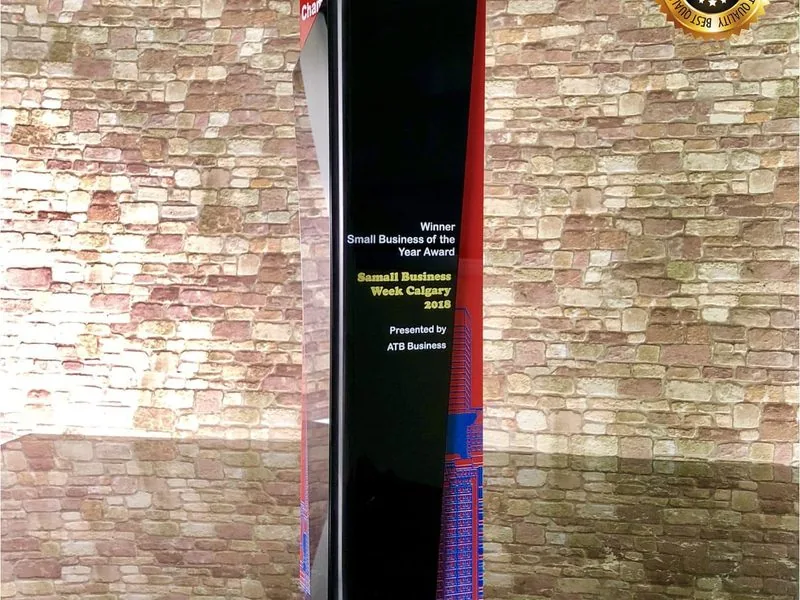
This is our most-used bespoke route by a wide margin. We take a 25mm or 30mm clear acrylic block, CNC-cut it into a custom silhouette (your logo, a building outline, a stylised athlete, a corporate icon), then UV-print or laser-engrave the citation onto the face.
Lead time: 1-2 weeks from approved render Pricing: the most accessible bespoke route, quoted per piece by size, edge polishing, base material and quantity Quantity sweet spot: 10-200 pcs Best for: category awards, annual dinner trophies, sales-conference recognition, anniversary plaques
The big advantage of acrylic CNC is the absence of tooling cost. We design the silhouette, cut it, you approve. No mould charge, no minimum order, no drama, five-piece runs are perfectly viable. The constraint is that you’re working in 2D-extruded shapes. You won’t get a fully sculptural figure (a basketball player mid-jump, a 3D logo with depth) from CNC alone. You can get close with multi-layer assembly (two acrylic pieces glued at angles) but it’s never the same as a true cast or moulded form.
Route B: Custom mould (resin/metal cast or injection)
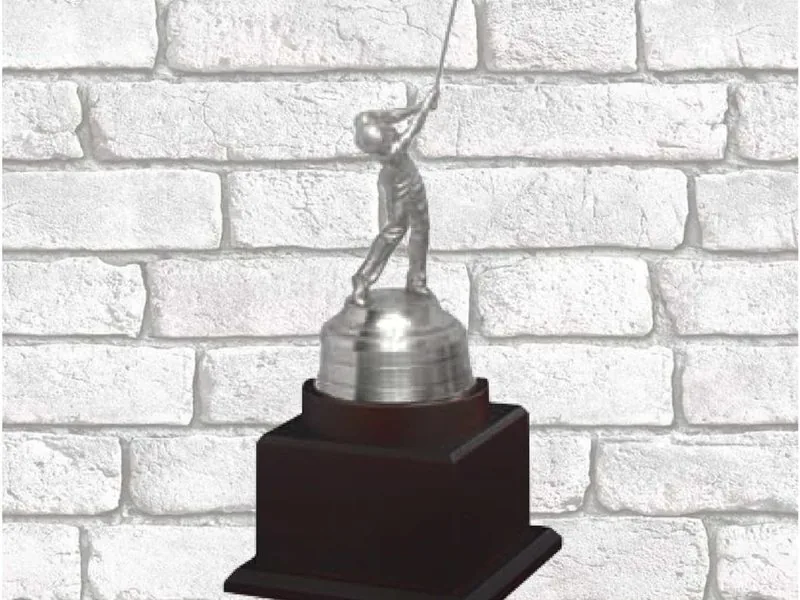
This is the route for genuinely sculptural trophies. Figurines, 3D logos with depth, organic curved shapes, branded forms that need to be held in the hand and felt as a single object.
Lead time: 4-6 weeks from approved prototype Pricing: quoted on spec by material, plating, size and run quantity Tooling: a one-off tooling cost, quoted case by case by complexity Quantity sweet spot: 50-500 pcs (below 50 the tooling kills the unit price) Best for: perpetual cups, multi-year sports leagues, branded category awards used annually, association flagship awards
Custom mould is where the tooling cost enters the conversation. We pay our partner workshop to build a mould (silicon for resin, steel for metal injection), cast the prototype, approve it, then run production. The mould is yours conceptually, re-orders 12 months later come back cheaper because there’s no tooling round two. The trap with custom mould is committing before you’re sure, once tooling is cut, design changes are expensive (sometimes impossible). The render and prototype review steps below exist precisely to prevent this. No drama if you take an extra week at the render stage. Major drama if you skip it.
Route C: Custom-sourced crystal
Some buyers want a fully bespoke crystal piece. A unique cut, a specific shape that doesn’t exist in any catalogue. We source these through long-time partner crystal workshops who can cut to spec.
Lead time: 2-4 weeks from approved drawing Pricing: the most premium route, quoted on spec by size, optical clarity grade and complexity of cut Quantity sweet spot: 5-50 pcs Best for: chairman/CEO awards, IPO commemoratives, hero pieces for a single event, ultra-premium recognition
Custom crystal is the slowest and the most expensive route. Optical-grade crystal is expensive raw material and the cutting and polishing process is labour-intensive. For a 5-piece executive-level run, it’s often the right call.
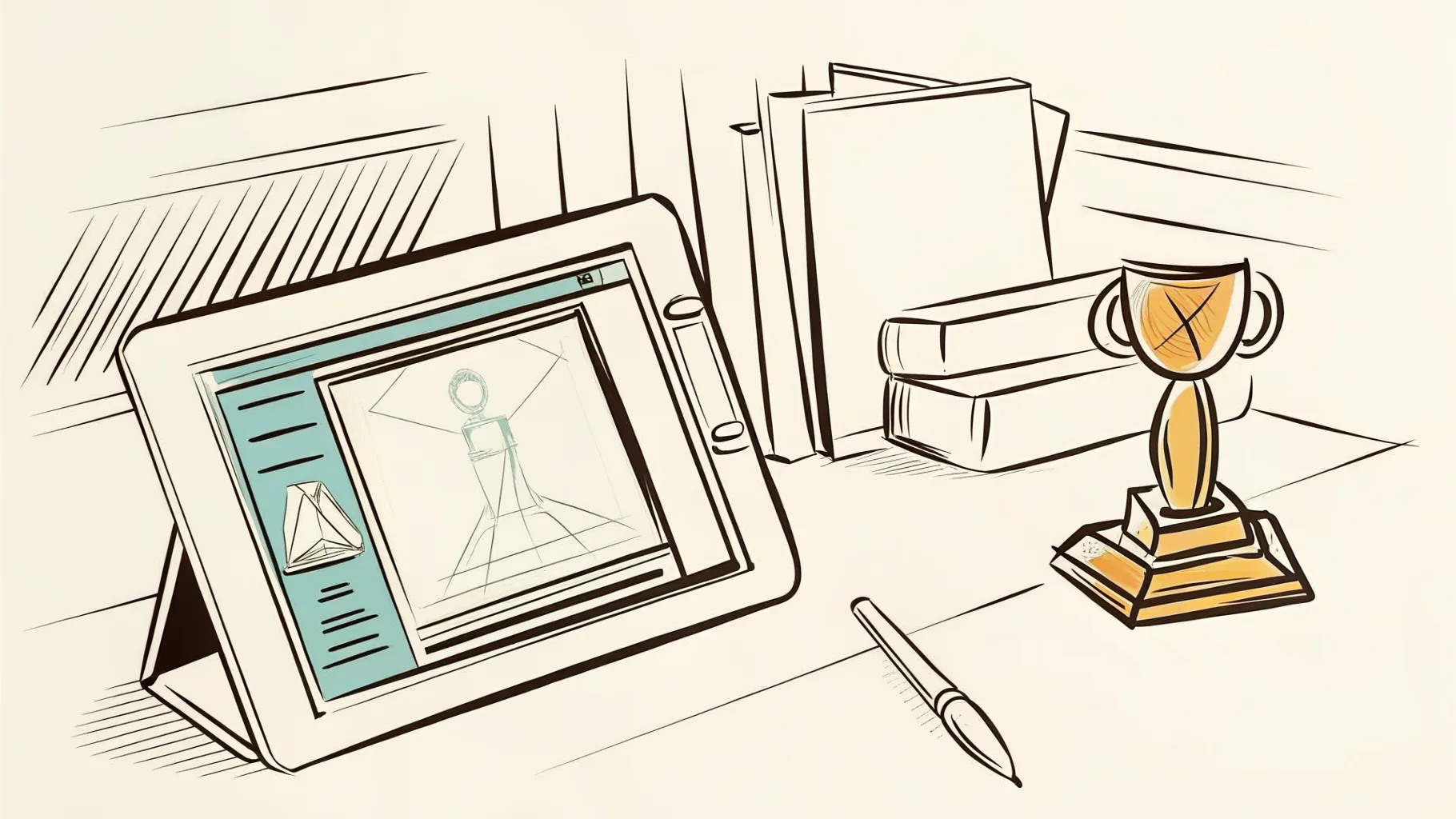
Step 3, CAD render approval (the load-bearing step)
This is the step where bespoke projects either de-risk or derail. The CAD render is the closest you’ll get to seeing the final piece before tooling, cutting or casting begins. Treat it as the contract.
Our designers will send one of three things depending on the route:
For acrylic CNC, a flat 2D vector showing the cut outline plus a coloured 3D mock-up showing the trophy on its base with engraving in place. You should be able to read the recipient’s name and the citation lines on the mock-up.
For custom mould, a turntable 3D render showing the trophy from front, side, back, and top. Plus a separate close-up of the engraving plate area. For figurines, expect a clay-render style first, followed by a textured render with material/plating shown.
For custom-sourced crystal, a technical drawing with dimensions, plus a rendered preview showing the cut and any internal laser engraving (if applicable).
What to check:
- Proportions. Is the trophy too tall? Too wide? How does it sit in a hand?
- Engraving plate size. Is there room for the citation you actually want to engrave? Long titles (“Anugerah Perkhidmatan Cemerlang 25 Tahun”) need real estate.
- Logo legibility. Render previews can hide tiny logos that won’t actually print well at 5mm tall.
- Material accuracy. Make sure the render matches the material brief, clear acrylic looks different to mirror-finish, polished pewter looks different to satin.
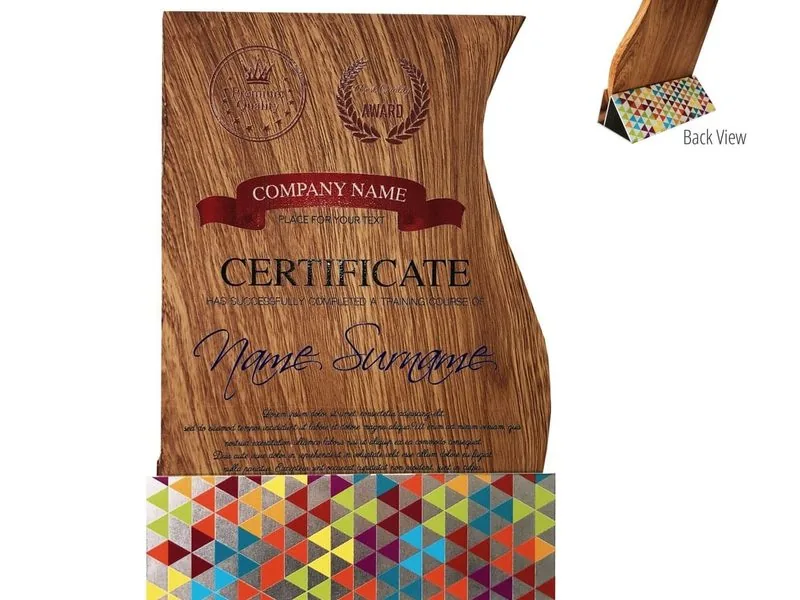
- Base material. A solid wood base feels totally different to a black acrylic base. Confirm before sign-off.
This is the moment to bring in your CEO, your HR director, your event committee. Whoever’s going to be in the photo handing out the trophy. If they have an objection, get it raised now. Once we move past render approval, we’re spending money.
Step 4, Physical prototype review (mould projects only)
For custom mould projects a single physical prototype is cast in the actual material before running the full quantity. On larger runs this prototype is part of the project; on smaller runs it’s quoted case by case.
You hold the prototype. You weigh it. You photograph it next to your other office trophies. You hand it to your boss and watch their face. You read the engraving out loud. If anything feels wrong, too light, too top-heavy, the engraving hard to read, the plating colour off, we fix it before mass production.
For CNC and crystal routes we typically skip the physical prototype because the route is more deterministic. What you see in the render is what you’ll get within a small tolerance. We can still arrange a single prototype if you want one, it just adds a week to the timeline.
The prototype review is also the moment to decide on packaging. Foam-cut presentation box? Velvet pouch? Branded sleeve? These are decisions you can make later, but if your event is in 6 weeks and packaging needs lead time, surface it now.
Step 5, Production run with three milestone checkpoints
Once the prototype is approved (or the render, for non-mould routes), production runs at our partner workshops. iTrophy designs and project-manages from our Brem Park office in Kuchai Lama. Manufacturing is handled by long-time Malaysian partner workshops we’ve worked with for years.
For your part, the production stage is mostly waiting. We’ll send progress photos at three milestones:
- First piece off the line, confirms the production output matches the prototype/render
- Mid-run check, confirms consistency at scale (especially for cast figurines where small batch-to-batch variation can creep in)
- Pre-dispatch QC, every piece individually inspected, engraving checked, packaged
If you spot anything off in the photos, raise it immediately. It’s far cheaper to pause production at the mid-run check than to receive 200 pieces and find a logo positioning error.
Production timelines from approved prototype:
- Acrylic CNC: 7-10 working days for runs up to 100 pcs, add 3-5 days per additional 100
- Custom mould (resin): 14-21 working days for runs up to 100 pcs
- Custom mould (metal): 21-28 working days for runs up to 100 pcs
- Custom crystal: 14-21 working days for runs up to 50 pcs
Step 6, Dispatch and delivery logistics
Once production and QC are signed off, dispatch happens from our Brem Park goods centre in Kuchai Lama. Pieces are foam-padded and boxed individually. For sculptural mould pieces with delicate features (figurines, crystal pyramids), each box gets an extra outer carton with bubble wrap.
- Klang Valley: same-day or next-day dispatch.
- Peninsular Malaysia (Penang, Johor, Kuantan, Ipoh): 1-2 working days.
- East Malaysia (Sabah, Sarawak): 5-7 working days, usually via Pos Laju or Citylink.
| Destination | Courier buffer to plan | Ceremony-safe target |
|---|---|---|
| Klang Valley | 1 working day after QC | Receive 3 working days before event |
| Peninsular Malaysia outside Klang Valley | 2-3 working days after QC | Receive 5 working days before event |
| Sabah / Sarawak / Labuan | 5-7 working days after QC | Receive 7-10 working days before event |
You pay the actual courier rate, no markup, and we quote it on the order. The tax invoice (ITROPHY BROTHERS PLT, registration 202504003677, LLP0045203-LGN) is issued on dispatch, and prices on quotes are SST-inclusive. All customisation work, engraving, logo etching, UV print, design rounds, is free.
For ceremony-day timing, build in a 3-day buffer. I’ve seen too many corporate buyers cut it to the wire and stress themselves out for nothing. If your event is on a Friday, aim for delivery the previous Friday. No drama.
The conversation I always have with first-time bespoke buyers (and the regret it saves)
Here is the design-stage conversation I have with every first-time bespoke buyer on WhatsApp before quoting tooling. It consistently saves them four-figure sums in regret-replacement orders.
I ask them to walk through where the trophy will physically sit in five years, in three years, in one year, and in one week.
This sounds soft. It is the most practical question in the brief. The time-horizon mental model surfaces design constraints that no PowerPoint deck or Pinterest board ever does:
- Week 1 (just after the ceremony): the recipient takes it home. Will it fit in a carry-on if they’re flying back to KK or Penang? A 350mm sculptural piece will not. We design the dimensions accordingly.
- Year 1: the trophy lives on the recipient’s desk at the office. Is it short enough not to block their monitor sight line? Is the citation legible from sitting eye-level? Is the engraving facing forward toward the room or backward toward the wall?
- Year 3: the recipient may have changed roles, departments, or moved to a smaller office. Is the trophy still meaningful (citation still relevant) or has it become institutional clutter? Pieces with personal-achievement framing age better than pieces with company-of-the-year framing.
- Year 5: the recipient may have left the company. The trophy is now in their personal collection at home. Does it still hold meaning detached from the corporate context? This is the test for whether the citation should reference the recipient’s personal achievement or the company’s recognition act.
- Year 20 (for chairman / lifetime / founder pieces): the recipient may no longer be with us, and the trophy is in a family living room or being passed to grandchildren. Does the citation tell a story the next generation can read and understand?
Walking through these horizons before the render stage typically produces a brief that’s noticeably smaller in physical footprint, often lower in unit price, and dramatically more likely to be photographed on the recipient’s desk years later. The bespoke pieces I’m most proud of all came from briefs that took this question seriously.
Brief us
Gather your four briefing inputs (reference images, target quantity, target unit price band, the story behind the award) plus a one-paragraph answer to the time-horizon question above, and send them to +60 12-213 6631. We come back the same working day during business hours with a route recommendation, a real RM band, and a calendar back-solved from your event date.
Related reading: custom mould vs stock shape, custom acrylic CNC trophy shapes, and the trophy proof approval process.
A custom mould you regret is more expensive than a stock shape you don't love. Spend time at the render stage, not the regret stage.