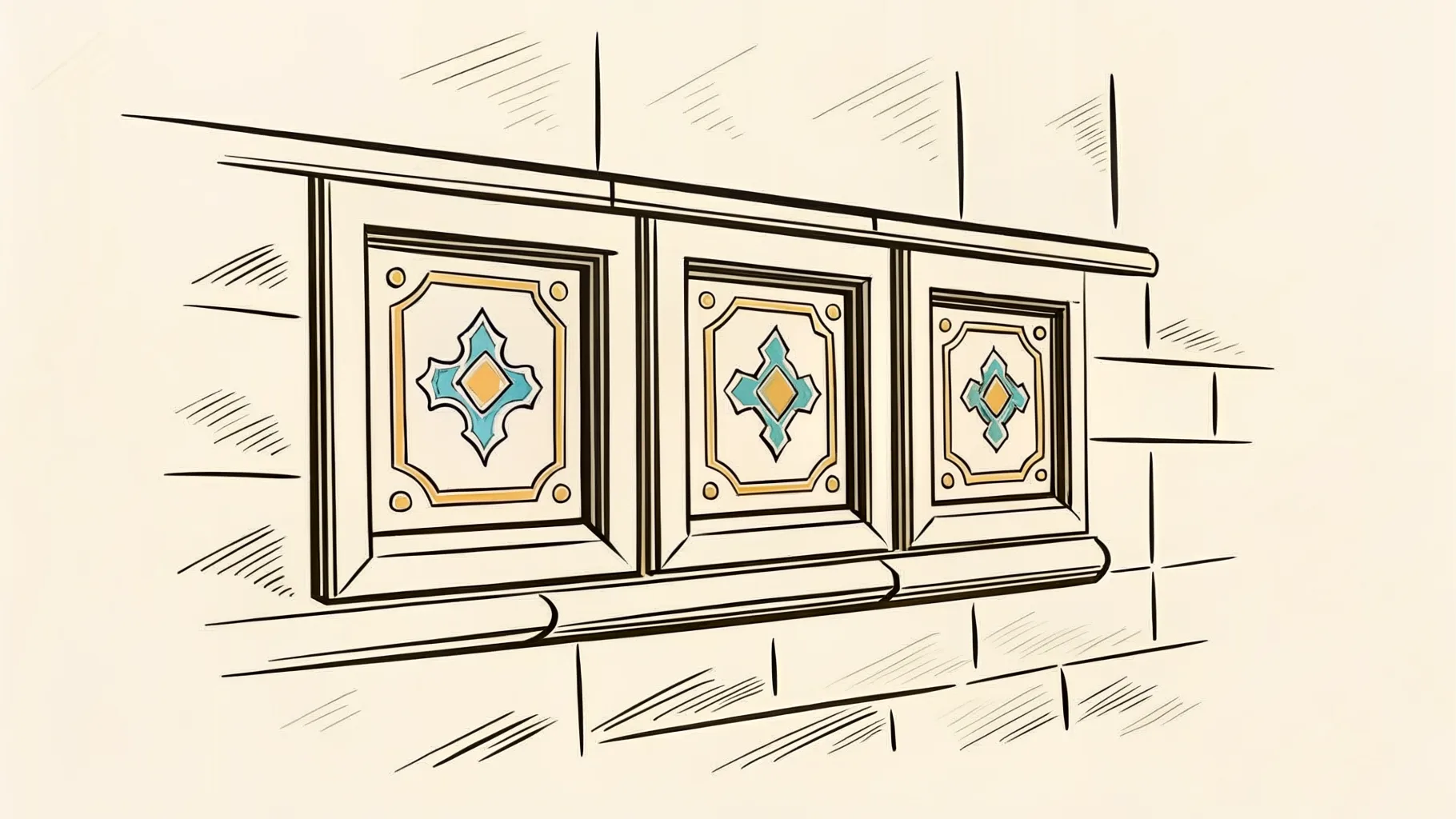
A donor plaque outlives the donor. It outlives the committee that voted on it, and usually the printer that ran the sample sheet. The brass-on-chengal piece in a sixty-year-old kampung mosque, names you’ve never heard, lettering still crisp after three decades of Friday afternoons, is the standard to design toward: the plaque you sign off this Saturday will hang in that same kind of room until 2055.
That permanence is the whole brief for religious recognition. It’s multi-generational, it sits on a sacred-space wall, and a trendy format reads as embarrassing within five years. A “modern” acrylic donor wall ordered today will look dated by 2031; traditional formats age with the building.
Short answer: Design conservatively and bilingually, and match the material and script to the community. Mosques: wood or pewter with brass, Jawi or Arabic + BM, and avoid crystal as it can read ostentatious. Churches: brass-on-wood, English with Mandarin or Tamil for ethnic congregations. Hindu temples: brass (it suits the temple aesthetic), Tamil + English. Gurdwaras: wood or pewter with brass, Gurmukhi + English. On donor walls, keep every plaque within a tier identical and let the tiers carry the hierarchy. Get the layout right once and it pays back across thirty years on the wall.
Why religious recognition is different from corporate
| Factor | Corporate plaque | Religious community plaque |
|---|---|---|
| Display lifespan | 5–10 years | 30+ years |
| Audience | Single generation of staff | Multi-generational, elders, mid-career, youth |
| Cultural sensitivity | Brand-tone matters | Language, material, motif all carry weight |
| Failure cost | Awkward design refresh | Permanent record on a sacred space wall |
These constraints push design toward conservative materials, traditional layouts, and bilingual engraving that respects the community’s primary language.
The Department of National Unity and Integration frames Malaysia’s religious diversity as a national strength. Institutional recognition pieces are part of how communities mark that.
Mosque plaques (Surau / Masjid)
The most common iTrophy religious recognition orders. Typical occasions:
- Donor recognition for mosque construction or renovation funds
- Board / committee service appreciation (ahli jawatankuasa)
- Imam / religious teacher recognition
- Anniversary plaques for milestone years (10, 25, 50)
- Hari Raya tribute for committee members
- Opening ceremony commemorative pieces
Material conventions for mosque plaques
| Material | Tier | Best for | Notes |
|---|---|---|---|
| Wooden plaque with brass nameplate | Standard | Most jawatankuasa, donor recognition | Walnut-stained sengon or rubberwood, brushed gold brass, conservative and respectful |
| Pewter plate with motif | Premium (quote on spec) | Major donor, imam tetap retirement | Often features Islamic geometric patterns or calligraphic borders |
| Brass plate on hardwood frame | Premium | Donor walls, opening ceremonies | Refined finish, ages well |
| Crystal | Generally avoided | n/a | Can read as ostentatious; conservative-traditional preferred for mosque settings |
Browse wooden plaques range for the standard mosque plaque format.
Note: standards under JAKIM and state mufti offices generally favour conservative material. When in doubt, lean traditional.
Inscription conventions
Bilingual is standard: Bahasa Malaysia + Jawi script (or Arabic + BM for more formal pieces).
Common citation patterns:
[ARABIC: bismillah ar-rahman ar-rahim]
DENGAN PENUH PENGHARGAAN
Tuan Haji [Nama] bin [Bin]
Ahli Jawatankuasa Pengurus
[Year - Year]
Untuk khidmat ikhlas kepada jemaah Masjid [Nama]
JAWATANKUASA MASJID [NAMA] · [Year]
For donor recognition:
PENAJA UTAMA
Yayasan [Nama] / Encik [Nama]
RM [Amount] · [Pembinaan / Penyenggaraan / Aktiviti]
Dengan setinggi-tinggi penghargaan
JAWATANKUASA MASJID [Nama] · [Year]
For Imam recognition:
PENGHARGAAN
Imam [Nama]
Khidmat sebagai imam tetap
[Year - Year]
"Saudara dan saudari yang dihormati..."
JEMAAH MASJID [NAMA]
For deeper guidance on bilingual + Jawi engraving handling, see Engraving Dwi-Bahasa.
Sensitive considerations for mosque plaques
| Consideration | Detail |
|---|---|
| Quranic verses | Use sparingly and only with proper consultation, incorrect rendering causes offence |
| Prophet’s name with PBUH | Render correctly with appropriate honorific (ﷺ or “peace be upon him”) |
| Imagery of living beings | Avoid, incompatible with Islamic art conventions |
| Calligraphy font choice | Jawi naskhi (formal) for institutional plaques; Jawi diwani (decorative) for special commemorative pieces |
| State mufti review | For major institutional plaques (mosque opening, foundation stone), some state mufti offices request proof review, ask the jawatankuasa |
Church plaques (Catholic, Protestant, Methodist, Seventh-Day Adventist, etc.)
Common occasions:
- Donor recognition for church building / renovation funds
- Board / consistory service for elders, deacons, vestry members
- Pastor / priest recognition for ministry milestones
- Anniversary plaques for church founding (centenary, sesquicentennial)
- Memorial plaques for departed members
- Opening ceremony pieces for new buildings
Material conventions for church plaques
- Wooden plaque with brass nameplate: most common, mirrors mosque conventions. Mahogany or walnut-stained for darker premium feel.
- Brass plate on wood frame: traditional church standard, especially for Anglican/Catholic settings.
- Marble plaque: premium tier, often used for memorial / donor recognition that’s wall-mounted.
- Crystal: appropriate for some contexts (anniversary pieces, pastor retirement gifts), less conservative-traditional than mosque/temple settings.
Inscription conventions
Language depends on congregation:
- English-medium congregations: English primary, sometimes with Mandarin or Tamil supplementary for ethnic-mixed congregations
- Mandarin-speaking congregations (Methodist, Pentecostal, Lutheran with Chinese congregation): Mandarin primary, English supplementary
- Tamil-speaking congregations (Tamil Methodist, Pentecostal Tamil): Tamil primary, English supplementary
- Iban / Bidayuh / Kadazan congregations in East Malaysia: BM or local language primary, English supplementary
Common citation patterns:
WITH GRATITUDE
Mr. & Mrs. [Family Name]
Founding Donor, Sanctuary Building Fund
[Year]
"From those to whom much is given..."
[CHURCH NAME] · Established [Year]
IN APPRECIATION
Pastor [Name]
Senior Pastor [Year - Year]
"For shepherding the flock with grace and wisdom"
[CHURCH NAME] · [Year]WITH SINCERE THANKS
[Name]
Elder [Year - Year]
[Brief 1-line specific contribution]
[CHURCH NAME] · [Year]Sensitive considerations
- Bible verses: appropriate with attribution (e.g. “Romans 12:11”). Choose verses fitting the recipient’s role.
- Cross or denominational symbols: standard, appropriate.
- Memorial plaques: use “In loving memory” or “Remembered with thanks”, never “RIP” abbreviated in formal pieces.
Temple plaques (Hindu)
Common occasions:
- Donor recognition for temple construction or annual functions
- Board / sabha service appreciation
- Priest / archana donor recognition
- Anniversary plaques for temple founding milestones
- Festival sponsor recognition (Deepavali, Thaipusam)
Material conventions for temple plaques
- Brass plate on wood frame: most common, brass aligns with temple aesthetic (golden bell, golden vimana).
- Wooden plaque with brass nameplate: similar to mosque/church conventions.
- Marble plaque: premium tier for major donor recognition walls.
- Crystal globe: occasionally for senior board service or visiting religious leader recognition.
Inscription conventions
Language depends on congregation:
- Tamil-medium temples (most Hindu temples in MY): Tamil primary, English supplementary
- Mandarin-medium temples (Chinese-Buddhist sometimes share Hindu spaces): Mandarin primary, Tamil + English supplementary
- Mixed Indian community temples: English primary, Tamil + Sanskrit supplementary for prayers
Common citation patterns:
[TAMIL: Mahabharata-quote attribution or "ஓம்"]
WITH GRATITUDE
Mr. & Mrs. [Name]
Major Donor, Temple Renovation Fund [Year]
[Brief Tamil + English citation]
[TEMPLE NAME] · [Year]
IN APPRECIATION
Mr. [Name]
Sabha Secretary [Year - Year]
For [N] years of devoted service
[TEMPLE NAME] · [Year]For Tamil + English bilingual engraving guidance, see Engraving Dwi-Bahasa.
Sensitive considerations
- Sanskrit verses: use with proper consultation, Sanskrit characters are common but rendering matters.
- Religious imagery (temple deities, Om symbol): appropriate when used respectfully and accurately.
- Caste-related references: avoid in modern recognition contexts (not relevant to most contemporary Malaysian Hindu temples).
Gurdwara plaques (Sikh)
Common occasions:
- Donor recognition for gurdwara building or community kitchen (langar)
- Sangat (committee) service for management committee members
- Granthi / preacher recognition for religious leaders
- Anniversary plaques for gurdwara founding milestones
Material conventions for gurdwara plaques
- Wooden plaque with brass nameplate: standard, similar to mosque/church.
- Pewter plate: premium tier, often with traditional pattern engraving.
- Brass on hardwood: traditional.
Inscription conventions
Language: Punjabi (Gurmukhi script) primary, English supplementary. Hindi sometimes for older community members.
Common citation patterns:
[GURMUKHI: ਵਾਹਿਗੁਰੂ ਜੀ ਕਾ ਖਾਲਸਾ, ਵਾਹਿਗੁਰੂ ਜੀ ਕੀ ਫਤਹਿ]
WITH GRATITUDE
[Name] Singh / Kaur
Sangat Secretary [Year - Year]
For devoted service to the community
[GURDWARA NAME] · [Year]
Sensitive considerations
- Khanda symbol: appropriate, common.
- Guru references: use full name (Guru Nanak Dev Ji, Guru Gobind Singh Ji) with appropriate honorifics.
- Mool Mantar verses: use with proper consultation.
Donor walls: tier hierarchy that works for 30 years
Donor walls combine many plaques on a single display surface.
The discipline is consistency within tiers and clear visual hierarchy between them.
| Tier | Plaque size | Material | Lifespan |
|---|---|---|---|
| Founders / Major donors | 12×16” or larger | Brass on hardwood, marble | 30+ years |
| Significant donors | 8×10” | Brass nameplate on wood | 25+ years |
| Contributing donors | 5×7” | Brass plate | 20+ years |
| Annual donors (rotating wall) | 4×6” | Brass plate | 5–10 years before refresh |
The single most-overlooked detail: layout consistency within tiers.
All Founders plaques the same format. All Significant Donors the same format. Mixed sizes and materials within a tier read as chaotic and disrespectful to the consistency of the gift relationship across years.
For donor wall planning that overlaps with broader corporate-style recognition programs, see Corporate Awards Malaysia and Long Service Awards Malaysia.
Lead time for religious community orders
| Order shape | Lead time |
|---|---|
| Single piece (custom citation) | 7–14 working days |
| Small batch (5–15 pieces, annual donor update) | 14–21 days |
| Donor wall installation (50+ pieces, full wall update) | 4–6 weeks |
| Anniversary commemorative (custom design + commission) | 4–6 weeks |
| Wood products (10× MOQ + ~1 week) | Add 1 week to above |
For major institutional events, mosque opening, church centenary, temple consecration, gurdwara prakash utsav, brief 6-8 weeks ahead.
These are dates that don’t move and don’t compress.
Pricing for religious community plaques
Wooden plaques with a brass nameplate are the workhorse format and sit in the bands below as rough planning figures. Pewter, marble, and full brass plates have no fixed list price because they vary so much by size and finish, so we quote those on spec, WhatsApp us the size and we’ll give a real number.
| Format | Per-piece guide |
|---|---|
| Wooden 5×7” + brass nameplate | RM 90 – 180 |
| Wooden 8×10” + brass nameplate | RM 150 – 280 |
| Wooden 12×16” + premium brass | RM 280 – 500 |
| Pewter plate with motif | Quote on spec |
| Marble plaque (small or large) | Quote on spec |
| Brass full plate (no wood backing) | Quote on spec |
Bulk pricing applies when ordering 10+ pieces with a consistent format (e.g. a donor wall update). WhatsApp us the quantity for a per-piece figure.
How to brief us
WhatsApp us at +60 12-213 6631 with seven fields:
- Religious context, mosque/church/temple/gurdwara/community organisation
- Occasion, donor recognition, board service, anniversary, opening, retirement
- Format direction, wooden, brass, pewter, marble (or “open to suggestions”)
- Language, primary + secondary scripts (BM/English/Jawi/Arabic/Mandarin/Tamil/Punjabi)
- Quantity, single piece, batch, full donor wall
- Citation text, recipient names, contributions, dates
- Deadline, event date or required-by date
For full institutional commissioning (e.g. donor wall design + installation), a walk-in to the Brem Park studio (Mon-Fri 9-6, Sat 9-1) is recommended, so we can discuss design, materials, and layout face-to-face.
For broader context that overlaps (CSR and volunteer recognition with religious community partnerships), see corporate awards Malaysia and appreciation plaques. For donor wall material specifically, see marble plaque Malaysia.
A donor plaque outlives the donor. The hour you spend getting the layout right pays back across the next thirty years on the wall.