Until a brief like this one, I ran East Malaysia deliveries the same way I ran KL ones: pack tight, dispatch on time, trust the cargo schedule. Now I run every Sabah and Sarawak job with a backup routing named before production even starts. The reason was a 50th-anniversary ceremony on a Sandakan palm-oil estate, and a Sulu Sea thunderstorm that grounded the only direct flight a day and a half before the pieces were due.
Nine pieces, a board ceremony deep in the plantation interior, a chairman of the founding generation, and a cargo consignment sitting on a forklift at KLIA while the destination airport closed for weather. A Sabah thunderstorm does not care about your delivery schedule. The schedule has to be built to absorb it. We rerouted via Kota Kinabalu, absorbed the extra cargo cost on our side, and the pieces reached the estate two days before the ceremony, on plan.
So this is the anatomy of a heritage East Malaysia delivery, and the logistics discipline it forced on us. I’m keeping the client composite on purpose; heritage family businesses value their discretion.
Short answer: Treat the cargo flight as the riskiest leg of the whole job. Build a 5–7 day buffer before the ceremony date, name a specific backup hub and partner courier before the brief locks (KK for Sabah, Kuching for Sarawak), and stage any bespoke custom-mould piece on its own design track in parallel with the standard pewter run. Hand-draw cultural motifs rather than pulling stock patterns. Bespoke and pewter pieces at this register are quoted case by case, so route the numbers to WhatsApp.
The brief at a glance
A half-century-old estate marking its 50th anniversary with a quiet board ceremony at the restored colonial-era plantation building it uses as HQ. Around thirty attending: the chairman, immediate family (several on the board), senior management, and a handful of long-time partners. Heritage register, bilingual. For context, the Malaysian palm-oil sector is regulated by the Malaysian Palm Oil Board (MPOB), and a 50-year operator with continuous family ownership is a genuine heritage benchmark in that world.
The piece list:
| Tier | Quantity | Spec |
|---|---|---|
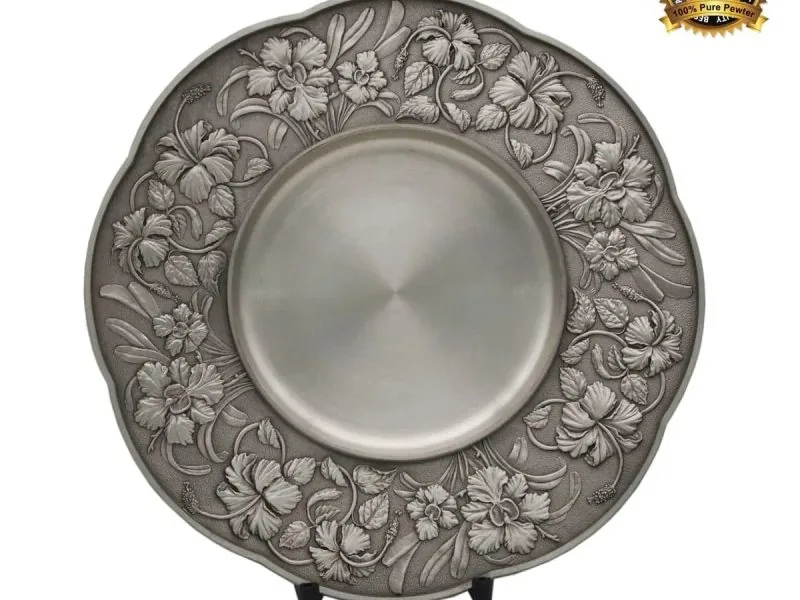
| Senior board pewter centrepiece | ~8 | Hand-finished pewter, front engrave + BM-bilingual reverse citation, hand-drawn batik motif border |
| Founder bespoke heritage crystal | 1 | Optical crystal, custom-cut profile inspired by an oil-palm fruit cluster, hand-set pewter plate |
The estate covered the cargo flight, and the final mile from Sandakan airport (a 90-minute 4WD haul into the plantation interior) was handled by the estate’s own plantation supervisor. Pewter and bespoke custom-mould crystal at this register are quoted case by case rather than from a list, so the piece count and references go to WhatsApp for a real number.
The aesthetic register was specifically heritage. The pieces had to feel considered and hand-made, not factory-finished, which is exactly why pewter suits this kind of brief: the weight, the warm patina, the association with heritage Malaysian craft. The batik motif border came from a textile reference the family shared through the corporate affairs manager, the kind of detail that means something to the recipient without him having to explain why.
The three calls that ran the brief
One: stage the bespoke heritage piece’s design and tooling separately from the pewter centrepieces. The bespoke crystal needed a custom mould, and custom-mould briefs run on a 2–6 week design and tooling window that has to start before the standard production track. So the bespoke design ran in the first few weeks, the mould locked around week four, and production followed in weeks five and six. The pewter centrepieces ran in parallel on the standard track, with production lock in week six and dispatch in week seven.
Two: build a 5–7 day cargo-flight buffer into the East Malaysia delivery plan. KL–Sandakan cargo runs daily, but the specific window each day is narrow, and weather, public holidays, and capacity can each push a piece by a day or more. So the plan put ready-to-ship pieces at the end of week seven, with a 5–7 day buffer before the ceremony, which set the brief sign-off a full eight weeks ahead of the ceremony date.
Three: hand-design the batik motif border rather than pull a stock pattern. This was a soft recommendation pushed hard. Stock batik patterns on pewter look like clip art; a hand-drawn motif that references a specific textile has a different quality entirely. The designer worked from a photograph the corporate affairs manager provided, redrew the motif at scale, simplified it for engraving, and proofed it with her before it went to the engraving plate.
One more thing I push for on East Malaysia briefs: the client’s logistics team gets a packing manifest before dispatch, each piece individually wrapped, tier-coded, listed by weight and dimension. The estate’s plantation supervisor used that manifest to plan the 4WD pickup at the airport.
The storm and the KK reroute
The pieces shipped from KL on the Thursday, three days before the ceremony. The original plan was an early-afternoon KL–Sandakan cargo flight, a Friday-morning pickup by the plantation supervisor, and the pieces at the estate by Friday afternoon, leaving all of Saturday as buffer.
Thursday afternoon the cargo desk called. A Sulu Sea thunderstorm system was hitting Sandakan airport visibility, and the direct flight slipped from Friday morning to Friday afternoon to Saturday morning. A Saturday-morning arrival left no buffer for any onward delay, and the storm wasn’t over.
| Decision | Cost | Outcome |
|---|---|---|
| Wait for the original KL–Sandakan flight | Nothing | Pieces possibly delayed past the ceremony date |
| Reroute via KL–KK then a KK–Sandakan relay | Extra cargo, absorbed by us | Pieces in Sandakan on the original Friday, despite the direct-flight delay |
KL–KK cargo was running on schedule; the storm was further east. So the consignment diverted to a KL–KK Thursday-afternoon flight, the partner courier in KK accepted it that evening, and a short onward leg put the pieces into Sandakan at first light Friday. The plantation supervisor collected on schedule, and the pieces reached the estate Friday afternoon, exactly as originally planned.
The Malaysian Meteorological Department cyclonic season runs October to April, and Sabah’s east coast catches the tail of those systems, so every March cargo plan needs a backup routing. The structural lesson: name that routing before the brief locks. Not “we’ll figure something out”, but a specific alternate hub, a specific partner courier, a specific ground-relay path. KK and Kuching are now standing alternate hubs for any Sabah and Sarawak delivery, with partner couriers pre-briefed to accept a redirect.
What landed at the estate
In a brief that runs clean, the pieces deliver a day or two ahead, and the corporate affairs manager unboxes them in the chairman’s presence before the formal ceremony. The moment you’re hoping for is the founder picking up the bespoke piece, taking it in, and asking how the motif was chosen, because that means the considered detail landed. The pewter centrepieces go to the board during the formal segment, and the founder’s bespoke piece ends up on permanent display in the estate’s reception hall.
The custom crystal mould is preserved at the partner workshop afterwards. Heritage clients often come back for the next milestone, and a held mould means the next commemorative piece starts from a known reference rather than from scratch.
Three permanent changes the storm paid for
| Change | What it costs | What it prevents |
|---|---|---|
| Pre-mapped backup routing as a hard checklist item at brief stage | 15 minutes of routing research per East Malaysia brief | Same-day scrambling when a flight gets weathered out |
| Standing relationships at the cargo desks of major KL–East Malaysia carriers | Ongoing partnership work | Hearing about a delay hours after the standard customer notification, not before |
| Written logistics briefing to the client’s team: primary route, backup route, fallback | One manifest per East Malaysia delivery | Estate-side confusion if a redirect happens mid-flight |
The broader East Malaysia trophy delivery guide goes deeper on Sabah and Sarawak logistics, and the plantation palm oil industry awards guide covers plantation-sector recognition specifically. The corporate awards Malaysia and custom trophy Malaysia guides cover the broader register. For the pieces themselves, browse pewter trophies and crystal trophies.
If you’re a corporate affairs lead at a Sabah or Sarawak corporate, plantation, or oil-palm estate planning a milestone ceremony, WhatsApp us at +60 12-213 6631 with your ceremony date, piece count, and any heritage references (a textile pattern, a family motif, a colonial-era building element) that should inform the design. You’ll get a proposal back with the East Malaysia logistics plan as a standing line item, not an afterthought.
A Sabah thunderstorm doesn't care about your delivery schedule. The schedule has to be built to absorb it.