Three sample discs on a marketing director’s desk under a daylight lamp. He picks each one up, holds it next to the brand swatch card, sets it back down. None of the three match. The closest is off by maybe two shades, a cooler version of the developer’s signature warm magenta. To anyone outside the brand team it looks identical. To the brand team it looks like a different company.
That’s the moment a colour problem becomes a year-long problem. A quarterly top-agent programme shares one tooling set and one colour profile across all four cycles. Get Q1 wrong and you’ve locked in four cycles of off-brand: same disc, same template, same wrong magenta, all the way to December.
So this is the anatomy of launching a brand-colour-critical recurring trophy programme, the kind I run for KL property developers, and the one meeting at Q1 you cannot skip. I’m keeping it composite on purpose; developers guard their agent numbers and their brand files.
Short answer: The brand colour is the whole job. Build a Q1 calibration round before any production run, inspect physical samples under the actual gala-venue lighting (not on a screen, not under office daylight), lock the profile, and retain a master sample disc as the reference for every later cycle. Design the runner-up piece as a smaller member of the same family, not a cheaper consolation piece. Then Q2–Q4 run on the same tooling with only the recipient list changing.
The brief at a glance
A mid-sized KL developer, residential and mixed-use, a couple of hundred agents across the Klang Valley. The marketing director and head of sales had pushed the recognition programme internally for a while before budget cleared. The context that makes recognition matter here: in a sales force of BOVAEP-registered agents who move between agencies, being publicly recognised as a top performer is a genuine retention lever.
The order shape per quarter, as a planning shape rather than a fixed quote:
| Tier | Quantity | Spec |
|---|---|---|
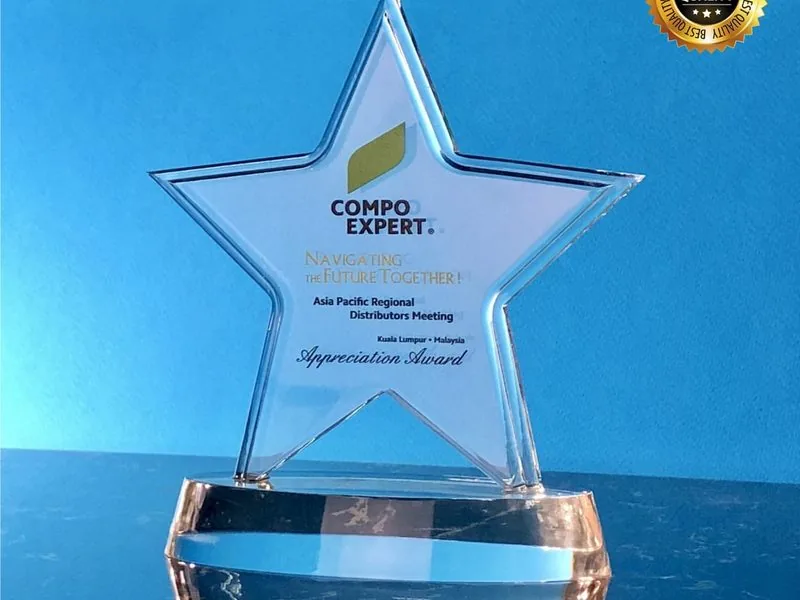
| Top-agent crystal | ~10 | 220mm optical-grade crystal, asymmetrical bevel, UV-printed brand-exact disc, brushed metal name plate |
| Runner-up acrylic | ~20 | Clear acrylic, brand-colour UV print, laser-engraved name |
| Tooling | Q1 only | Disc template + plaque setup + locked colour profile, amortised across the year |
The crystal sits in the premium band and the runner-up acrylic well below it; the custom tooling is a one-time setup quoted upfront and spread across the four cycles. WhatsApp us the cohort sizes and we’ll quote the cycle and the tooling as real numbers.
The aesthetic register was modern, minimalist, brand-tight, with the primary palette specified in Pantone. The marketing director wanted the colour to land exact, not approximate. This is a developer whose visual identity carries across hoardings, sales-gallery displays, brochures, and now trophies. If the colour was off, the trophy was off. If the trophy was off, the agent would clock it, and the marketing director’s internal credibility on the programme took the hit.
The three calls that ran the launch
One: invest in the tooling once at Q1, amortise across the year. Custom moulds and custom UV-print templates carry a setup cost. The honest framing for the client is that the first cycle feels front-loaded because it carries the tooling, and the later cycles are lighter because they don’t. Averaged across four cycles it fits the budget envelope, provided the same tooling carries across all four without re-setup fees. That last point goes in writing at Q1 sign-off.
Two: build a brand-colour calibration round before the first production run. UV print on acrylic is colour-accurate, but the substrate and the lighting both shift the perceived colour. A colour that reads correctly on a brand brochure can read shifted on a translucent acrylic disc under hotel-ballroom lighting. So the calibration round runs like this:
- Print a few sample discs at slightly different colour profiles
- Send the client a physical sample of each
- Let them inspect under their actual gala-venue lighting
- Pick the profile that lands
It costs about a week and a small sample-run fee. On a four-cycle contract, that week is the cheapest insurance you’ll buy all year.
Three: design the runner-up acrylic to read as a deliberate companion piece, not a downgrade. Recurring programmes risk a “winners get the good piece, runners-up get the cheap piece” dynamic that quietly demoralises the runner-up cohort. The fix is to give the acrylic plaque the same visual language as the crystal block, same brand-colour disc, same font hierarchy, same mounting style, at a smaller scale. It reads as a smaller member of the same family, not a different family entirely. That keeps runner-up recognition feeling like genuine recognition.
One more thing I push for on recurring programmes: a single recurring point of contact on the client’s side and a single recurring account lead on ours. Quarterly programmes are operationally simple if the brief is identical cycle-to-cycle and the only variable is the recipient list. They become hard if the brief drifts every quarter.
The two-shade-off moment
Here’s how the calibration round usually earns its keep. The first round comes back on schedule, a few sample discs each tagged with their profile code. The client inspects them in the actual gala ballroom, under warm tungsten downlighting that pushes the brand colour orange against a daylight reference. None land cleanly. The closest is a couple of shades off.
The decision is simple in hindsight, hard in real time: ship the closest, or re-calibrate and lose a production week. On a four-cycle contract you re-calibrate, every time, because the Q1 colour profile is also the Q2, Q3, and Q4 profile. Wrong at Q1 means wrong four times.
So the partner workshop pulls in a colour-matching specialist, the kind who works on signage and premium packaging, and runs a fresh profile against a Pantone-bridged reference. A new sample goes to the client’s desk the same afternoon by same-day courier for inspection under their own lighting, and gets approved within the hour.
The Pantone Matching System gives you a target. UV print on translucent acrylic gives you a real-world result. The gap between target and result is exactly what calibration closes.
The single most useful trick for brand-colour-critical programmes: send the sample to the client’s actual desk by same-day courier, not on a 24-hour courier leg. Same-day inspection in real lighting cuts the proof loop from days to hours.
I now build a second-calibration buffer week into every launch schedule for brand-colour-critical recurring programmes. Most don’t need it. The handful that do, save a fortnight.
What landed at the gala
In a clean launch, the pieces deliver to HQ a few working days before the Q1 gala. Marketing sets up the recognition display in the ballroom on the morning, the MD presents the top tier personally, the head of sales presents the runners-up, and the internal social posts go up the following week. The compliment you’re listening for is a winner asking whether the piece was custom-made. That’s the highest praise a trophy earns at a recognition gala.
From there, Q2, Q3, and Q4 run on the same tooling, the same colour profile, and the same account lead, each delivering on a fortnight’s notice once the recipient list is confirmed. That’s the whole point of locking the brand colour at Q1: the hard work is done once, and the rest of the year is just names.
Three permanent changes the calibration round pays for
| Change | What it costs | What it prevents |
|---|---|---|
| Second calibration buffer week, scheduled by default | One slot in the production calendar | A cycle-1 colour miss cascading across all four cycles |
| Sample inspection in the actual venue lighting (or the client’s desk via same-day courier) | One same-day ride per launch | Approving a profile that reads wrong on the night |
| Tooling terms locked commercially across Q1–Q4 at Q1 sign-off | A signed line in the Q1 scope | A switch-and-bait on tooling cost mid-contract |
I keep an internal note on the lighting profile of the major KL hotel ballrooms we’ve delivered to. If a client names the venue, we already have a good idea whether the brand colour will push warm.
The corporate awards Malaysia and custom trophy Malaysia guides cover recurring-programme procurement, and the case studies hub covers adjacent proof points. Browse crystal trophies for the top tier and acrylic trophies for the companion pieces.
If you’re a marketing director or sales-operations lead at a Malaysian property developer, WhatsApp us at +60 12-213 6631 with your agent count, recognition cadence, and brand reference, Pantone codes, vector logo, hex if you have it. You’ll get a four-cycle proposal back with the calibration weeks already built into the schedule.
Brand-Pantone-exact on UV print isn't a fancy ask. It's table stakes for a developer whose entire identity hangs on the colour landing right.